
A fleet submission comes back unquoted because vehicle number 14 appears twice, once on the ACORD 127 and once on the ACORD 129, so the underwriter never priced the risk at all. Four days disappear while the file gets corrected, and by then the account has gone to whoever sent a submission that added up the first time.
Fleet submissions get kicked back more often than any other commercial auto risk, and the reason is structural rather than careless. A fleet is too large to fit on one form, so it spreads across a stack that all describes the same vehicles and drivers, and every form has to agree with the others. This article covers the reconciliation that keeps them agreeing.
The Power Unit Trap That Breaks Most Fleet Reconciliations
This is the error most likely to be sitting in a file right now, and it is also the one brokers most often try to correct in the wrong direction.
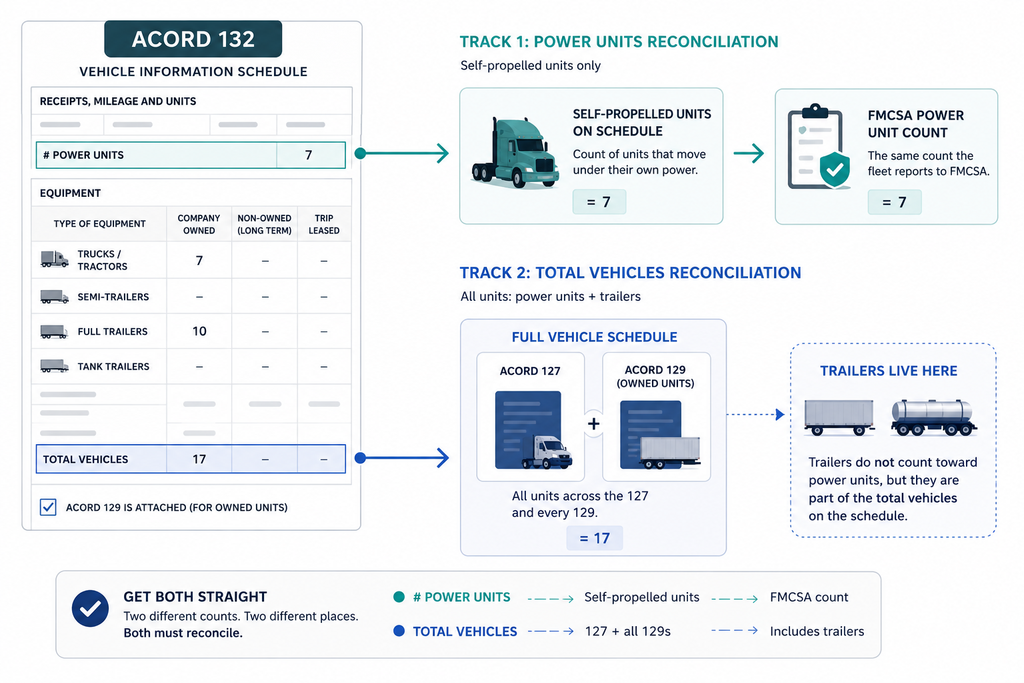
The ACORD 132 carries vehicle counts in two separate places, which is where the confusion begins. There is a # power units field in the receipts, mileage and units block, and there is also an equipment grid that breaks the fleet out by type, with rows for trucks, tractors, semi-trailers, full trailers, tank semi-trailers, tank trailers, refrigerated trailers, service trucks, private passenger autos and a total vehicles line.
Those two figures are supposed to differ on most fleets, because power units count self-propelled vehicles only. Trailers do not count toward the power unit total, and only vehicles that move under their own power qualify, so an operation running seven trucks and ten trailers reports seven power units. Owned trailers still belong on the schedule, though, because the 132 directs owned units to the ACORD 129, which carries body type, VIN, gross weight and cost new for each one.
A broker who reconciles the power unit field against the full scheduled unit count will therefore find a gap on every trailer-pulling fleet, and closing that gap introduces a genuine error into a file that was already correct. The reconciliation runs on two separate tracks instead:
- The # power units field agrees with the self-propelled units on the schedule, and with the power unit count the fleet reports to FMCSA.
- The total vehicles line on the equipment grid agrees with the full unit count across the 127 and every 129, trailers included.
expand_more Centered Image close
Getting those two straight makes a whole category of phantom mismatches disappear.
Cross-form checks that prevent a kicked-back submission
Run these before the file leaves your desk, since each one takes seconds and each one catches a real bounce. The reasoning behind them matters as much as the checks themselves, because a broker who understands why a field reconciles will also catch the variants of the same error.
1. Vehicle numbering runs continuously from the 127 onto the 129. Both forms carry a vehicle number field, and the standard convention numbers units sequentially from 1, so when the 129 restarts at 1 or repeats a number already in use the schedule stops reconciling. This is the most common fleet kickback of all, and it happens easily because the current 127 holds four vehicles in its description section while each 129 holds five.
2. Power units and total vehicles reconcile on their own tracks. As covered above, the power unit field matches the self-propelled units while the total vehicles line matches the full schedule.
3. Ownership status agrees across the grid, the schedule and the general questions. The 132 equipment grid splits every vehicle type across company owned, non-owned, long term lease and trip lease columns, and carries a box confirming the 129 is attached for owned units. The 127 then asks separately whether any vehicles requested for insurance are not solely owned by and registered to the applicant, with fields for the vehicle number and the name of the other owner. Owned units belong on the schedule while trip leased and non-owned equipment appears in the grid without necessarily appearing there, so those three places have to tell the same story.
4. Radius agrees between the grid and the vehicle records. The equipment grid carries radius columns for local, intermediate and long distance along with a territory and zone column, and those have to agree with the radius stated per vehicle on the 127 and the 129, both of which carry a radius field for each unit. Carriers examine radius harder than almost any other field because it drives rating directly, which means an inconsistency reads as a risk signal rather than a typo.
5. Every driver’s vehicle number points at a real unit, and the roster is complete. A driver assigned to a unit missing from the schedule breaks the link between the roster and the fleet. The 127 also instructs you to list all drivers including family members who drive company vehicles and employees who drive their own vehicles on company business, which means the roster runs wider than the payroll does.
6. Driver numbering on the 163 continues from the main form. Watch the edition here, because published guidance puts the 163 trigger at more than thirteen drivers in one place and more than twelve in another, while agency system documentation describes systems generating a 163 at lower counts still. Those numbers reflect different form editions and different software behavior, so confirm what you are actually filing against the ACORD forms index rather than working from a remembered number.
7. Terminal distances agree with garaging and radius. The 132 lists terminals with vehicle counts and distance from garage, so when a terminal distance contradicts the garaging addresses on the schedule the operation being described stops making sense.
Agency system pre-fill deserves a mention here, because ACORD forms sit inside your management system and certain fields pre-fill automatically, which removes a great deal of keying. Pre-fill handles the main form reliably enough, while the reconciliation across overflow schedules and the 132 remains the part that needs a human pass.
The Questions That Decide How the File Gets Read
Several general information questions carry more weight than their size suggests, and leaving them blank costs credit the fleet has already earned.
Telematics is asked in far more detail than most brokers answer. The 127 asks whether you have electronic monitoring devices that record and transmit data in any of your vehicles, then asks what percentage of the overall fleet is monitored on a scale of 1 to 100, then asks how the devices are used, with boxes covering fuel consumption tracking, vehicle maintenance monitoring, mileage tracking, location tracking, navigation and driver safety monitoring. A yes with no percentage and no usage detail tells an underwriter almost nothing, while a complete answer describes an actual risk management program.
Driver recruiting is a question on both forms. The 127 and the 132 each ask whether the applicant has a specific driver recruiting method, and both also ask whether the applicant obtains MVR verification on drivers and whether a vehicle maintenance program is in operation. That recruiting question matters more than its placement suggests, because ATRI research found that allegations of improper hiring or onboarding generate an expected increase of 272.3% in total awards. A blank there sits directly on top of the exposure underwriters are pricing hardest.
Both forms ask what is missing from the schedule. The 127 asks whether any vehicles are owned but not scheduled on the application, and the 132 asks whether the applicant owns or operates equipment not listed. Answering those honestly matters more than it looks, for the reason covered in the next section.
Cargo routes the file. The 132 asks whether the applicant hauls dangerous, caustic, radioactive or flammable cargo, and separately whether it hauls target commodities such as pharmaceuticals, liquor, meat or seafood, so a wrong answer sends the submission to a market that was never going to write it.
Filings: what the 194 does not tell you
The 194 records that filings are required, while the mechanics behind it trip up brokers regularly, so two distinctions are worth carrying.
The MCS-90 and the BMC filing are separate obligations that often get conflated. The MCS-90 is an endorsement added to the liability policy, and it is not filed with FMCSA directly, while the BMC-91 or BMC-91X certifies to FMCSA that the MCS-90 has been issued. A carrier can hold the endorsement and still show as non-compliant when the BMC filing did not post correctly, which is why both have to be in order at once. The two forms answer different program structures, since a BMC-91 covers a full required limit carried by a single insurer while a BMC-91X applies when that limit is split across more than one, which matters on any fleet large enough to need a tower.
Filings tie back to the schedule more directly than most brokers expect. Published guidance on FMCSA requirements notes that policies carrying the MCS-90 require every truck owned or operated to be listed and insured, which is the reason both application forms ask about equipment that is owned or operated without appearing on the schedule. A unit missing from the 129 on a filed policy is a considerably bigger problem than a re-rate, and filing the wrong limit for the operation stalls the account entirely, since authority stays inactive until the filing posts.
What the ACORD Stack Does Not Cover
Completing the forms does not complete the file, and two attachments account for a large share of the follow-up questions that arrive after a submission goes out.
Loss runs are generally expected to be currently valued and issued by the carrier, covering three to five years. Two failure modes recur here: the runs are stale and valued months back, so the underwriter cannot rely on the figures, or they are agency-prepared rather than carrier-issued, which most markets will not accept. Order them early, because the incumbent carrier controls the turnaround and a renewal deadline does nothing to accelerate it.
Carrier and MGA supplementals sit on top of the ACORD stack, which functions as the floor rather than the ceiling. Many fleet markets add a supplemental application covering driver hiring standards, maintenance programs, safety policy and operational detail that the ACORD forms never reach, so a broker who finishes the stack and treats the file as complete receives a request for the supplemental in place of a quote. Check the target market’s requirements before you assemble the file rather than after.
When a File Does Come Back
A 40 unit fleet can lose an account to a numbering sequence nobody checked, where renumbering the schedule takes twenty minutes and getting back into the underwriter’s queue takes four days. Recovery is worth planning for, because those four days are partly avoidable.
Fix everything at once rather than patching the single field that was flagged, because a file that returns twice for two different reasons loses its place in the queue twice.
Call rather than resending silently, since a resubmitted file entering the queue cold sits behind everything received since it left, while a short note explaining what was corrected gives the file a reason to be picked up sooner.
Send the corrected forms as a complete set, because partial replacements create version ambiguity and an underwriter working from two copies of a schedule will stop and ask which one governs. Log the reason it bounced as well, since the same error recurs across a book more often than most desks realize.
For the Receiving Desk: MGAs and Wholesalers
An MGA or wholesale desk sits on the receiving end of these same forms and carries a different version of the problem, because the reconciliation errors arrive rather than originate.
Three habits reduce the drag considerably. Publish a submission standard for retail partners that names the forms, the loss run vintage and the supplemental you require, so that incomplete files become the exception. Triage at intake rather than at underwriting, because a missing 129 identified on arrival costs a same-day email while the same gap found mid-review costs a full cycle. Return corrections as a specific list rather than a general request, since a broker who receives one clear list will resubmit once instead of twice.
The volume problem is sharper here than at any retail agency, because a desk clearing dozens of fleet files a week runs the same reconciliation on every one of them, and checks that take seconds on a single file start to consume real headcount across a queue.
Where AI Automation Earns Its Place
The pre-send pass works well on one file and strains across a queue, because every fleet that spills onto overflow schedules multiplies the number of checks, and those checks are mechanical rather than analytical. That combination is exactly what automation handles well.
InEvo’s Document Parsing Agent handles commercial ACORD forms parsing and populates the schedules from a single extracted record, so the vehicle numbering, the unit counts and the driver references all derive from one source instead of being keyed across several forms separately. The errors described in this article are almost entirely errors of transcription between documents, which is the category that disappears once the documents draw from the same record. Its email plugin takes submission intake and error handling directly from the inbox, which is where a receiving desk feels the volume first.
The company reports 95 percent accuracy on ACORD data extraction and 80 percent fewer submission errors, along with teams handling three to five times more quotes, all figures it attributes to its own platform and worth weighing the way any buyer weighs a vendor’s own numbers.
Automation does not resolve the judgment calls, though. Whether a unit belongs on the schedule or in the grid, whether a fleet’s radius profile matches what the operation actually does, and whether a market will accept a given supplemental all still need a person. The division that holds up is a simple one, where the reconciliation gets automated and the interpretation stays human.
A Pre-send Checklist for Fleet ACORD Forms
Run this every time, since none of it requires software.
- Vehicle numbering runs continuously from the 127 through every 129.
- The power unit field matches self-propelled units, and the total vehicles line matches the full schedule.
- Ownership columns on the 132 grid agree with what is scheduled on the 129 and with the sole ownership question on the 127.
- Radius on the 132 grid agrees with radius stated per vehicle.
- Every driver’s vehicle number resolves to a unit on the schedule.
- Driver numbering on the 163 continues from the main form, on the edition you are filing.
- Terminal distances agree with garaging addresses and stated radius.
- One 137 for each garaging state on the policy.
- ACORD 194 attached wherever filings are required, with the correct limit for the operation.
- Named insured and FEIN match the legal entity exactly, suffixes included, and match the FMCSA record.
- Currently valued carrier-issued loss runs attached, covering three to five years.
- Carrier or MGA supplemental completed where the target market requires one.
- Telematics answered with the monitored percentage and the usage detail, not only a yes.
- Recruiting method, MVR verification, maintenance program and cargo questions all answered.
- Application signed and dated, with an effective date that has not passed.
expand_more Centered Image close
Submit Clean the First Time
Fleet submissions bounce more than other auto risks because a fleet is the only commercial auto account large enough to fragment across overflow schedules, and those fragments have to reconcile with each other through a process that is entirely mechanical.
The market also gives less room for a second attempt than it used to, since commercial auto has now run a fourteenth consecutive year of underwriting losses, totaling $4.9 billion in 2024 alone, and appetite has narrowed alongside it, which the companion piece on what slows a fleet submission covers in more depth.
Three moves cover almost all of it. Keep power units and total vehicles on separate tracks, run the cross-form checks before you send, and answer the general information questions in the detail the forms actually ask for.
Do those and the file gets priced instead of returned.
*NOTE: Form references in this article are to the ACORD 127 (2015/12), ACORD 132 (2012/04) and ACORD 129 (2009/11). Confirm the current edition against the ACORD forms index before filing, since field placement and driver thresholds vary by edition.