For an MGA, the hours spent on one submission are easy to overlook. Across hundreds or thousands of submissions, those hours become a capacity problem.
Account teams spend time opening documents, finding information, completing forms and following up on missing answers. Underwriters can then spend part of their day working through the same information before they can focus on the risk itself. Producers and brokers feel the result through slower responses and more back-and-forth.
The time between a broker sending a submission and an underwriter being able to review it is therefore part of quote turnaround. Understanding where that time goes is the first step toward improving it.
What Slow Quote Turnaround Time Costs an MGA
The cost of a slow quote is closely tied to how much work the MGA can handle with its existing team.
If every submission requires a set amount of manual preparation, a larger submission pipeline creates a corresponding increase in operational workload. Account teams have to process more files while underwriters have a larger pool of accounts waiting for review.
Deloitte’s research on specialty insurance highlights the scale of this constraint. It reports that many specialty insurers process only 20% to 30% of the submissions they receive, with disconnected systems, manual data re-entry and fragmented workflows contributing to the bottleneck. Its analysis suggests that modern underwriting workbenches can accelerate time to quote by around 40% and increase underwriter productivity by 25% to 30%.
Those figures relate to broader underwriting-workbench transformation so they should not be treated as a benchmark for submission intake alone. They demonstrate, however, that the work surrounding underwriting can materially affect an insurer’s ability to use its existing capacity.
There is also a commercial consequence.
Brokers may be approaching several markets at once which means the time available for an MGA to respond and compete for an account is limited.
For an MGA leader, the relevant measure is therefore more than the total number of submissions received. It is also how much of the team’s capacity is consumed getting those submissions ready for underwriting.
Where MGA Submission Intake Delays Actually Start
The delay starts with the way information arrives.
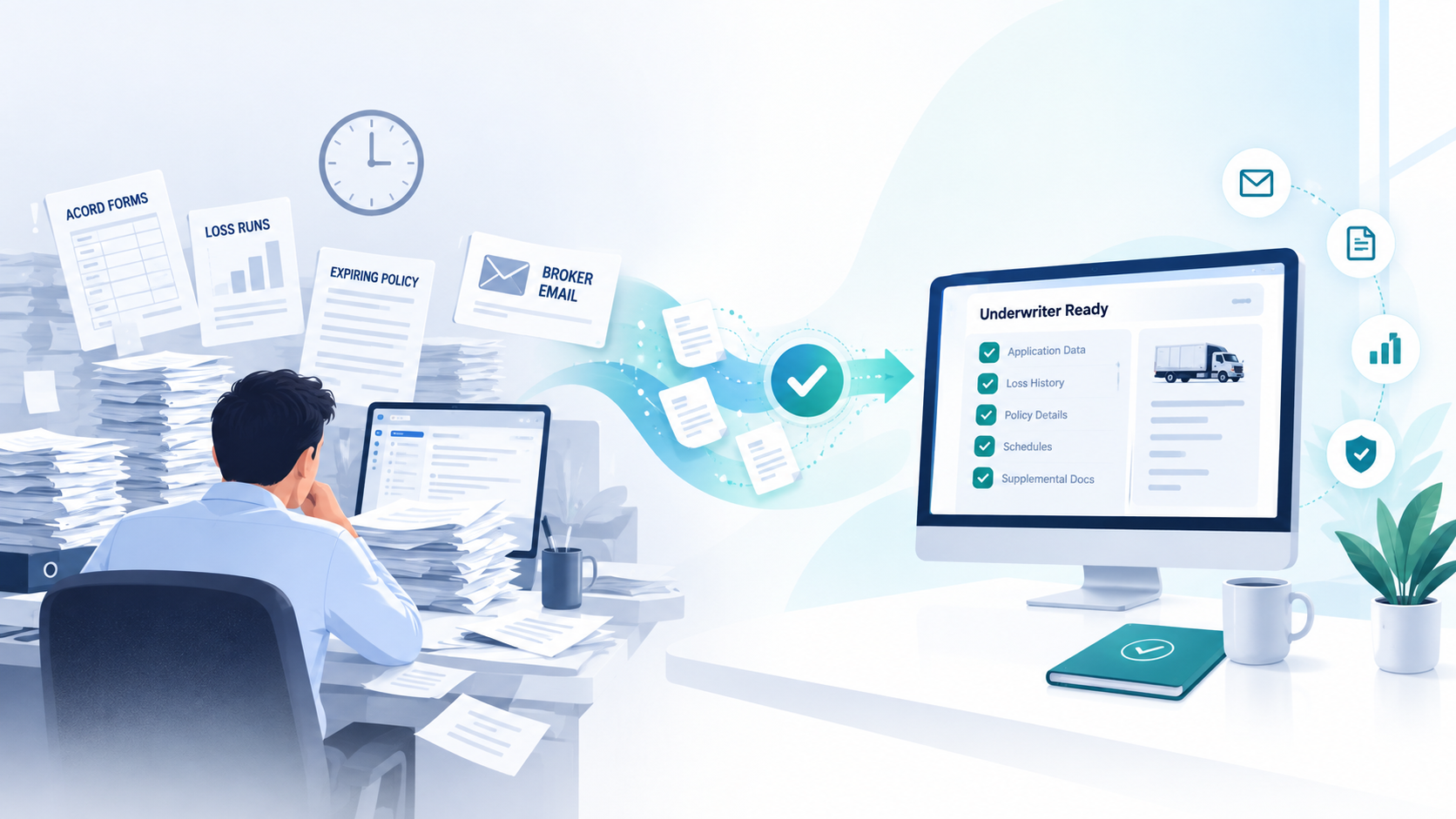
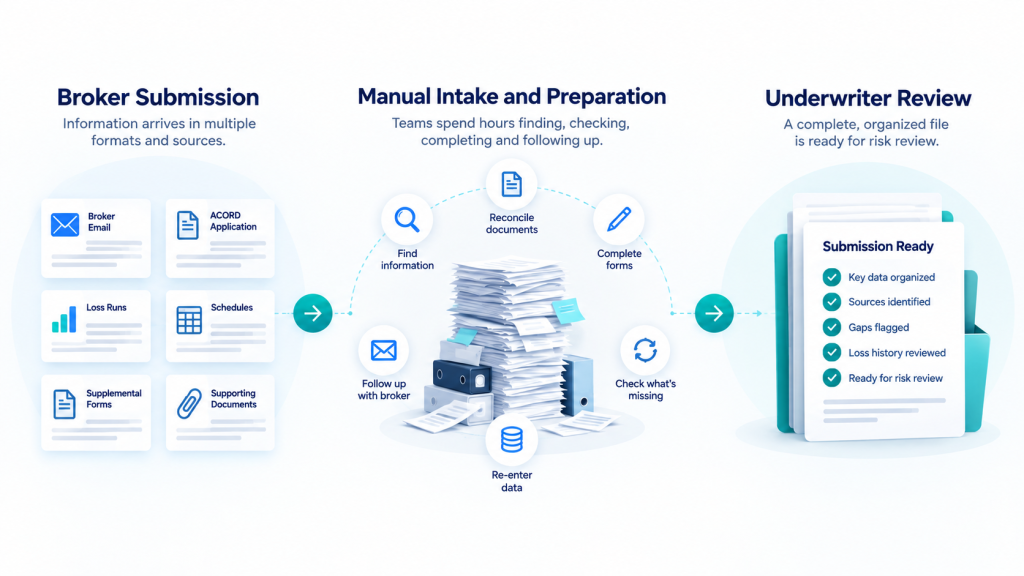
A commercial submission can contain an ACORD application, loss runs, an expiring policy, schedules, supplemental applications, correspondence and other supporting documents. The information needed to understand the account is distributed across these materials, often in different formats.
Someone has to bring it together.
The account team needs to establish what information is already available, where it came from and whether different documents agree. It also needs to determine what is genuinely missing.
That creates an important distinction in the intake process. A field can look incomplete on an application while the answer is already contained in an attachment or email thread. If that information is overlooked, the broker may be asked for something they have already provided. If a genuine gap is missed, the issue may only surface when the underwriter reviews the account.
The submission then needs to be prepared for the markets being considered. Forms have to be completed, supporting information has to be organized and the file needs to be presented in a way that allows the underwriter to begin the risk review.
McKinsey’s June 2026 analysis of commercial and specialty underwriting describes this workflow as one that can involve reading broker emails, extracting facts from documents, chasing missing information and moving cases between stages over days or weeks. It identifies submission intake as an area where technology can ingest information from multiple sources, check completeness and consistency, and create a structured case for underwriting.
Manual preparation also creates rework. The same information may be entered into several forms, values may differ between documents, or an error may only become visible after the file has moved further through the process.
Each of these issues adds another step before the account can receive underwriting attention.expand_more Centered Image close
Why Hiring More Staff Does Not Fix Intake Delays
When intake volume increases, adding people can distribute the workload. The underlying work required for each submission remains.
Every account still needs to be opened, reviewed, organized and prepared. Forms still have to be completed, information reconciled and genuine gaps followed up.
The challenge becomes greater when experienced underwriters are drawn into that process.
An underwriter’s value comes from applying knowledge of a line of business, evaluating risk and making decisions that shape the portfolio. When preparation work reaches the underwriting desk, part of that expertise is being used to get the file ready rather than assess it.
This creates two different capacity constraints. Account teams are limited by the amount of preparation they can complete, while underwriting teams are limited by the number of accounts they can properly evaluate.
Hiring can increase the number of people available to perform the work. Reducing the work required per submission changes the economics of the process itself.
That distinction is becoming more relevant as insurers invest in technology to reduce repetitive work. EY’s recent insurance GenAI research found that 68% of firms are adopting automated data entry. Insurers reported realized GenAI cost savings of mostly 5% to 10% over the previous one to two years, while 55% expected future savings of 11% to 20%.
The figures cover insurance broadly rather than MGAs specifically, but they show where organizations are looking for measurable value from AI: reducing repetitive activity and creating additional operating capacity.
How AI Submission Intake Cuts MGA Quote Turnaround Time
Much of the information required for a commercial submission already exists in the broker’s email and attachments. AI can be useful at this stage because it can work across those documents, organize the information and identify areas that require attention.
InEvo applies AI to this part of the workflow.
The platform reads the broker email and its attachments, including ACORDs, loss runs, expiring policies and schedules. It extracts information into a shared answer bank, with each field carrying its source page and confidence.
It then identifies information that remains open and asks for missing answers. Information already found in the submission can be reused, reducing the need to search through the original documents each time a form or question requires it.
The effect is different for each team involved.
For account managers and CSR teams
The account team can work from one set of submission information when preparing the forms required for an account.
InEvo’s workflow supports ACORD 125, 126, 127, 130 and 140, along with D&O forms and carrier supplementals. Information captured from the submission can be reused across those outputs rather than being entered separately into each one.
The team can review extracted information, correct it when necessary and see its source. Tenant-specific corrections can also be retained for future submissions.
That leaves the account team focused on exceptions and information that genuinely requires its attention.
For underwriters
The value for underwriting comes from having the relevant information organized before the risk review.
InEvo’s MGA workflow reads and ranks five years of loss history, reconciles paid and reserve amounts against incurred losses, enriches information such as FEIN and NAICS, and identifies open items.
The underwriter can therefore see the available information, supporting sources and outstanding questions in the context of the account.
The division between AI analysis and underwriting judgment is important. InEvo uses deterministic appetite rules outside the AI model path. The AI extracts and disambiguates information, while configured rules determine whether the submission meets the stated appetite. The underwriter remains responsible for evaluating the risk and making the underwriting decision.
This reflects a broader direction in commercial underwriting, where AI is increasingly being applied to routine information handling while human underwriters retain responsibility for complex and consequential decisions (ref: McKinsey analysis.)
For MGA owners and leaders
For an MGA leader, the opportunity is to change how capacity scales with submission volume.
If the amount of preparation required for each account falls, additional submissions can move through the operation without creating the same increase in administrative workload. Underwriters can spend a larger share of their time on risk evaluation, while account teams can focus on exceptions and broker interaction.
AIG provides one example of what this can look like at scale. Its 2025 annual report says its AI-enabled Underwriting by AIG Assist helped Lexington increase the number of submissions handled by 26% year over year in 2025. It also reports a 35% improvement in submit-to-bind ratio for Lexington Middle Market Property following the technology’s rollout. These are AIG-specific results, not industry benchmarks, but they illustrate the potential business impact of improving underwriting workflows.
For an MGA, the relevant question is how much of its own team’s time is currently spent preparing information that already exists somewhere in the submission.
Faster Quote Turnaround Starts Earlier
Quote turnaround is shaped by the work that happens before an underwriter begins the risk review.
For an MGA evaluating its own process, five measures can reveal where intake is consuming capacity:
How many people touch a submission before underwriting begins?
How long does it take to move from broker email to an underwriting-ready file?
How often is the same information entered more than once?
How frequently does the underwriter have to search through documents to find information?
How much of the team’s time is spent preparing submissions versus evaluating them?
These measures give an MGA a practical baseline for deciding whether its constraint is submission volume, underwriting capacity or the work required to move information between the two.
AI submission intake provides one way to reduce that workload. The technology can read documents, organize information, identify missing items and prepare forms, while people remain responsible for review, exceptions and underwriting judgment.
InEvo is designed around this model. Its six-week pilot focuses on one line of business, one desk and 30 real submissions, with the model deployed in the client’s environment and evaluation results retained by the client.
For an MGA, improving quote turnaround starts with understanding how much work happens between the broker’s email and the underwriter’s review. That is the part of the process where operational capacity can be measured, improved and, with the right technology, recovered.