Fleet submissions are being reviewed more closely in 2026 than they were five years ago.
Nuclear verdicts continue to rise. Carriers are pulling back from the trucking segment, and rates have not meaningfully eased.
For brokers, that pressure shows up as greater scrutiny: more documentation required for every unit and driver, tighter underwriting standards, and less tolerance for incomplete files.
The result is a higher standard for what qualifies as a clean fleet submission.
Understanding what slows these submissions—and addressing those issues before the file reaches an underwriter—can make the difference between getting the first quote back and losing valuable time in the market.
Why the Market Changed—and Why Brokers Feel It
The median nuclear verdict against corporations now sits at approximately $51 million, compared with $21 million in 2020.
At the same time, commercial auto liability has remained unprofitable by industry measures for fourteen consecutive years.
Several carriers have responded by reducing their exposure to trucking, pushing more fleet risks into the excess and surplus market.
By the time those market conditions reach a broker’s desk, the effect is practical.
Fewer carriers with appetite mean fewer opportunities to place each account. More selective underwriting means that a thin driver schedule, outdated loss runs, or inconsistent fleet information can cause a submission to be set aside rather than worked.
The market has raised the standard for a complete submission.
The brokers who meet that standard fastest are better positioned to get the first quote back—and the first competitive quote still has an advantage.
The Two Litigation Factors Changing Fleet Documentation
Driver quality has become one of the areas where incomplete submissions create the greatest risk.
ATRI research found that improper-hiring allegations can increase expected nuclear-verdict awards by more than 272%.
That changes how an underwriter looks at a driver schedule.
Missing hire dates, incomplete driving experience, or gaps in MVR information are no longer simply administrative issues. They can signal a risk that the carrier may prefer not to take.
This is where a defensible risk narrative becomes important.
Driver qualification files, coaching records, maintenance logs, and hours-of-service compliance provide evidence that a fleet actively manages driver behavior and safety.
That documentation also helps counter litigation strategies that attempt to portray a fleet as indifferent to public safety.
A fleet that can produce those records presents a materially different risk from one that cannot. The broker’s role is to surface that evidence before the underwriter has to ask for it.
Another shift is happening around MVR monitoring.
Annual MVR reviews have traditionally been the baseline, but they can miss violations, suspensions, and other license actions that occur between renewal dates.
A growing number of carriers now expect continuous license monitoring.
For brokers, that creates an opportunity to coach clients before renewal rather than discovering the issue during remarketing.
How to Structure the Telematics Request
Telematics has become an active underwriting input.
In many cases, the absence of telematics data can be interpreted as an absence of active risk management.
Underwriters commonly want approximately 90 days of consistent driving-behavior data before it becomes meaningful for underwriting.
The challenge is that clients rarely maintain this information specifically for insurance purposes. A vague request from the broker often produces an equally vague response.
A better approach is to make the request specific:
- Define the window. Ask for the previous 90 days of data so the underwriter receives a meaningful operating history.
- Specify the metrics. Request hard braking, speeding, harsh cornering, and hours-of-service compliance rather than asking for a generic telematics export.
- Include coaching records. Raw driving scores provide limited context on their own. Pairing the data with evidence that the fleet responds to unsafe behavior creates a stronger underwriting story.
- Explain why the data matters. Position telematics as a negotiation tool rather than a monitoring exercise. Verified data can help an underwriter distinguish a well-managed fleet from one that cannot demonstrate how it controls driver risk.
A structured request turns a difficult data-collection exercise into a clear list the client’s fleet manager can act on immediately.
Match the Fleet to Carrier Appetite Before Burning the Market
Fleet insurance appetite depends on factors that are unusually specific to the line.
Operating radius and lanes, commodities hauled, hazmat exposure, age of operating authority, number of power units, vehicle classes, garaging state, and CSA history can all influence whether a carrier wants the account.
The same fleet can look attractive to one carrier and become an immediate decline for another.
In a hard market, submitting a risk to a carrier that was never going to write it wastes both time and market access.
Two habits help prevent that.
First, match the fleet’s radius, commodity, authority age, and CSA history against the carrier’s stated appetite before sending the submission.
Second, keep the operating story consistent across every market. Contradictory information creates unnecessary underwriting questions and weakens confidence in the file.
More difficult fleets also need the correct channel from the beginning.
New-authority operations, hazmat haulers, and high-CSA fleets may be better suited to an MGA, wholesaler, or excess and surplus market, along with any required filings such as the MCS-90.
Radius deserves particular attention.
Carriers scrutinize inconsistencies between stated operating radius, lanes, and garaging information. What looks like a simple data-entry error can become a reason for an underwriter to question the entire submission.
Getting that information right the first time can be the difference between receiving a quote and receiving a re-rate.
Why Fleet Data Is Often Stale by Renewal
A fleet does not remain static throughout the policy term.
Vehicles are added and removed. Drivers turn over. Filings change. Certificates are issued to shippers with additional-insured or waiver wording that needs to remain consistent with the coverage in force.
Every change affects the underlying record of the fleet.
The problem appears at renewal when the vehicle and driver schedules submitted twelve months earlier no longer represent the actual operation.
A late remarketing effort then becomes a reconstruction project.
Schedules have to be rebuilt under deadline pressure. Brokers recollect information the client has already provided. Clients answer the same questions again. And the likelihood of errors increases.
The better approach is to treat the fleet schedule as a living record.
Adds, deletes, driver changes, and other material updates should be captured throughout the policy term.
Then, when remarketing begins, the broker is updating changes rather than rebuilding an entire fleet from zero.
The brokers who consistently protect their renewal timelines are often the ones who never allow the underlying schedule to become stale.
A Pre-Submission Check That Prevents Common Kickbacks

Before a fleet submission leaves the broker’s desk, a short consistency review can catch many of the issues that cause underwriters to send files back.
Check that:
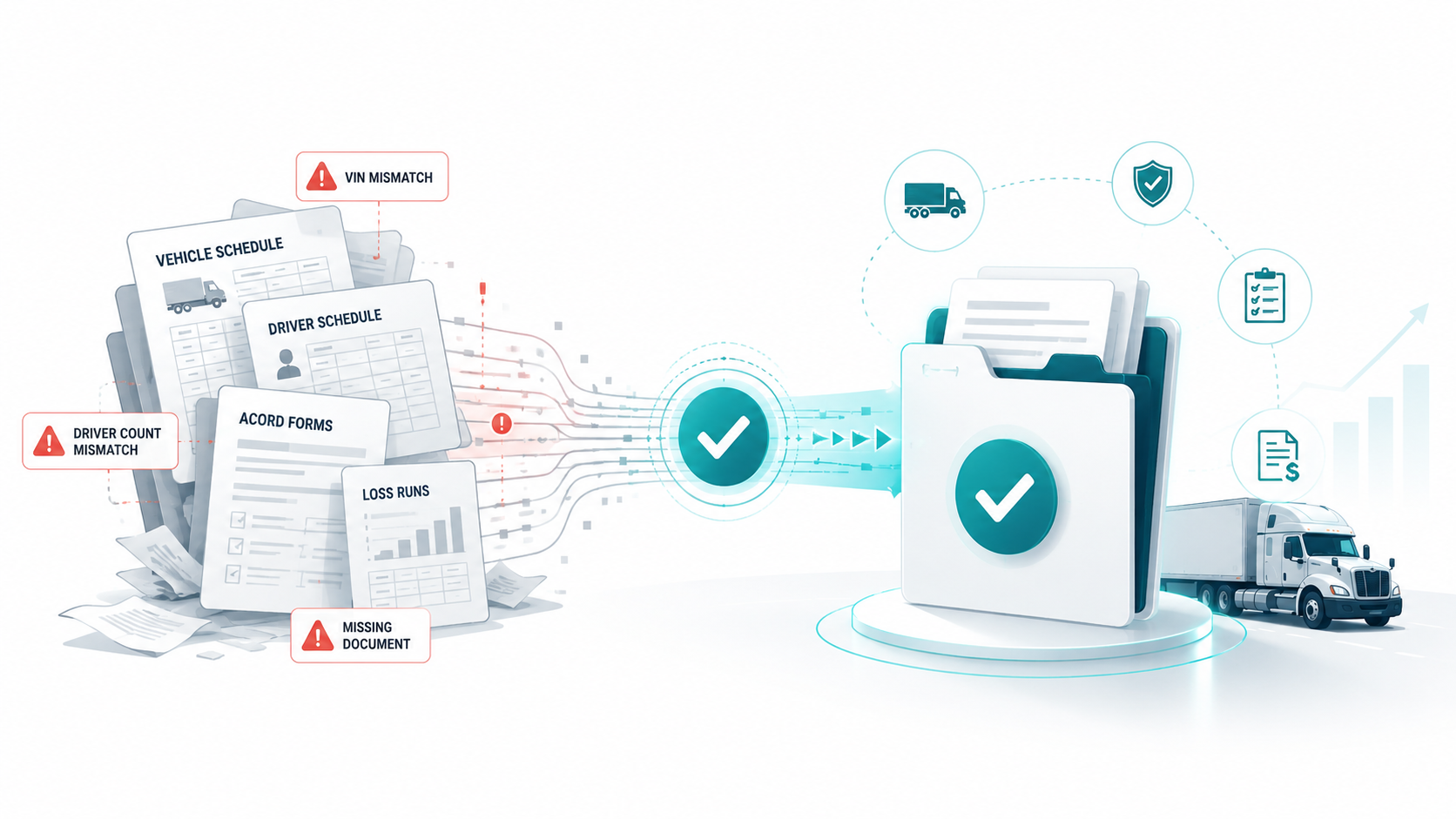
- Vehicle counts match across every form and schedule.
- Driver counts reconcile with power-unit counts, with no missing hire dates or license numbers.
- VINs are verified and every unit includes GVWR, cost new, and garaging information.
- Garaging ZIP codes are consistent with the stated operating radius and lanes.
- The named insured and FEIN exactly match the legal entity, including suffixes.
- DOT and MC information matches the public FMCSA SAFER record for entity, address, and authority status.
- Three to five years of currently valued loss runs are attached.
- Target limits, deductibles, and required filings are clearly stated.
None of these checks requires sophisticated technology.
They require a consistent process.
Running this review before the submission reaches an underwriter is one of the simplest ways to improve turnaround time because every item on the list represents a potential reason for a file to be returned.
Where AI Helps—and Where It Does Not
Volume is one of the biggest operational challenges in large fleet submissions.
As fleet size increases, vehicle schedules, driver records, loss data, and supporting documents grow with it.
That is where automation becomes particularly useful.
Parsing vehicle and driver schedules, reconciling VIN and driver counts across forms, extracting unit-level information from loss runs, and processing inbound emails containing multiple attachments are repetitive tasks that software can perform faster and more consistently than manual re-entry.
This is the part of the workflow InEvo is designed to address.
Its Document Parsing Agent extracts vehicle and driver information from source documents and uses that data to populate ACORD schedules, helping keep figures consistent across forms.
Its Quote Management Agent processes inbound emails and attachments so missing information can be identified during intake rather than later in the submission process.
InEvo reports 95% accuracy on ACORD data extraction and 80% fewer submission errors. These are company-reported platform figures and should be evaluated as such.
But AI does not replace underwriting or brokerage judgment.
A model cannot fully interpret the nuance of a CSA profile, determine whether an unusual hazmat or new-authority fleet belongs with a particular market, or replace the relationships a broker has built with carriers.
Human review remains essential.
A confidently incorrect VIN can create more problems than a blank field that an experienced person immediately knows needs attention.
The useful division of work is straightforward:
Automation handles the retyping, reconciliation, extraction, and chasing.
The broker handles placement strategy, coverage decisions, carrier relationships, and client conversations.
Closing Thoughts
What slows a fleet submission in 2026 is not one isolated form or underwriting requirement.
It is the volume, consistency, and freshness of the underlying fleet data.
Vehicle schedules, driver records, loss history, telematics, operating details, and supporting documentation accumulate at a scale few other commercial lines experience—and that information begins becoming outdated as soon as the fleet changes.
For brokers, the common thread is control of that data.
Structure the telematics request. Keep vehicle and driver schedules current throughout the policy term. Match the risk to carrier appetite before submitting. Run a consistency check before the file leaves the desk.
Those are the practices that protect renewal timelines, reduce unnecessary rework, and improve the chances of getting the first competitive quote back—regardless of which tools sit behind the process.