Client
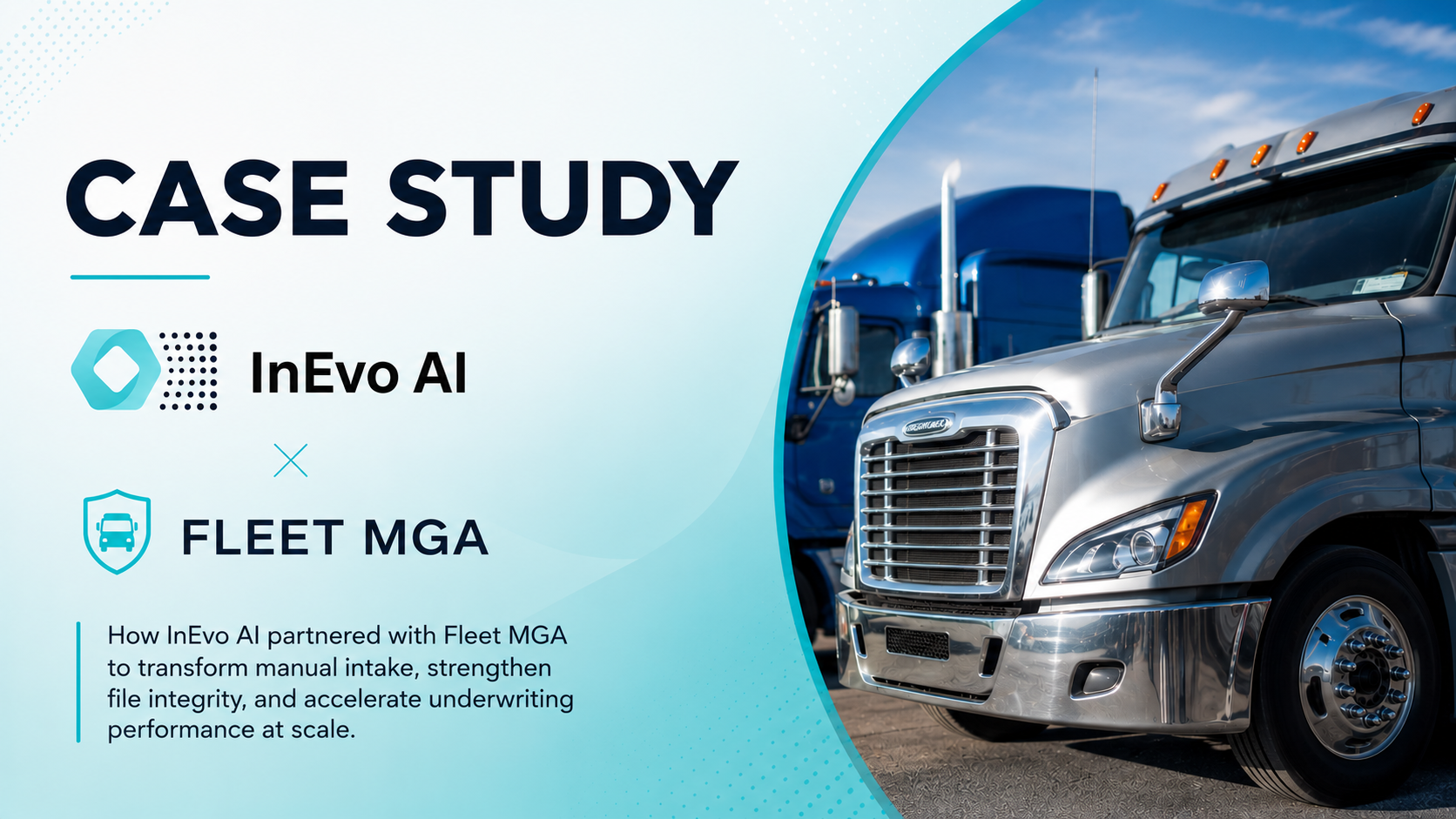
A Los Angeles based fleet MGA writing commercial auto. The MGA specializes in vehicles that operate within controlled environments and it serves a localized area with a particular risk profile.
The variables in the book were more predictable than in a general commercial auto portfolio which made the business a strong candidate for automated intake.
The underwriting itself is still demanding. Fleet risk turns on driver schedules and safety cultures so the quality of the file decides the quality of the decision.
For an MGA, submission management is the main lever on both underwriting throughput and portfolio profitability.
Problem
Manual intake had become a structural barrier to scaling.
Underwriters worked from raw paperwork. They validated unverified documents by hand and managed fragmented files, with emails and attachments sitting disconnected from each other. Every submission started with data entry. Loss run data was re-keyed by hand before a risk could be assessed and the same named insured and risk data was entered again on every required form in the packet.
The work around the submission was manual too. Sorting incoming email, chasing missing documents and following up with brokers all sat with the team.
Three main bottlenecks:
- Turnaround: Submission to a verified, carrier ready packet took five days. Business went to carriers who responded faster.
- Capacity: Highly skilled underwriters were sidelined by the administrative work of triaging disorganized documentation. They spent the day as data gatherers, and monthly volume was limited by manual bandwidth. Growth meant adding headcount.
- File integrity: Repetitive manual entry produced errors and that data decayed as it moved downstream toward the quote. Underwriters also ended up handling files that were incomplete or outside the MGA’s appetite so discrepancies could reach a quote and let risky business into the portfolio.
Solution
InEvo AI was configured to the MGA’s commercial auto appetite.
Automated data capture. Submissions, loss runs and driver schedules are read on arrival. Named insured and risk data are extracted once and mapped across every required form.
Intelligent sorting and tagging. Emails are automatically tagged, then flagged, approved or denied based on the MGA’s appetite and business rules.
Multi source compliance check. Driver and vehicle data is verified against DMV records, Verisk ISO MVR and SambaSafety before a quote is built. Underwriters work from a verified file rather than raw paperwork.
Automated broker follow up. When documentation is inadequate, the system contacts the broker and handles routine follow ups on its own.
System integration and assignment. Completed submissions flow directly into the client’s policy admin system. The underwriter receives the full submission with specific notes.
The workflow below shows where each step sits between intake and output:expand_more Centered Image close
Phase one handles intake, extraction and verification, so every document is read and checked against DMV, Verisk ISO MVR and SambaSafety before anything moves forward. Phase two handles alignment, assignment and output, so the finished submission lands in the policy admin system with notes already written for the underwriter.
Outcome
expand_more Centered Image close
The MGA moved to a human out of the loop intake process that scales with demand. Underwriters analyze more than 25 submissions a day without adding risky business, and each risk is completely analyzed.
Submission to verified, carrier-ready packet now runs in under four hours, against a previous manual process of five days. Manual data entry is down 80%. Intake accuracy on commercial auto stands at 99%.