Some brokers lose commercial accounts because the submissions aren’t ready when the underwriter opens them.
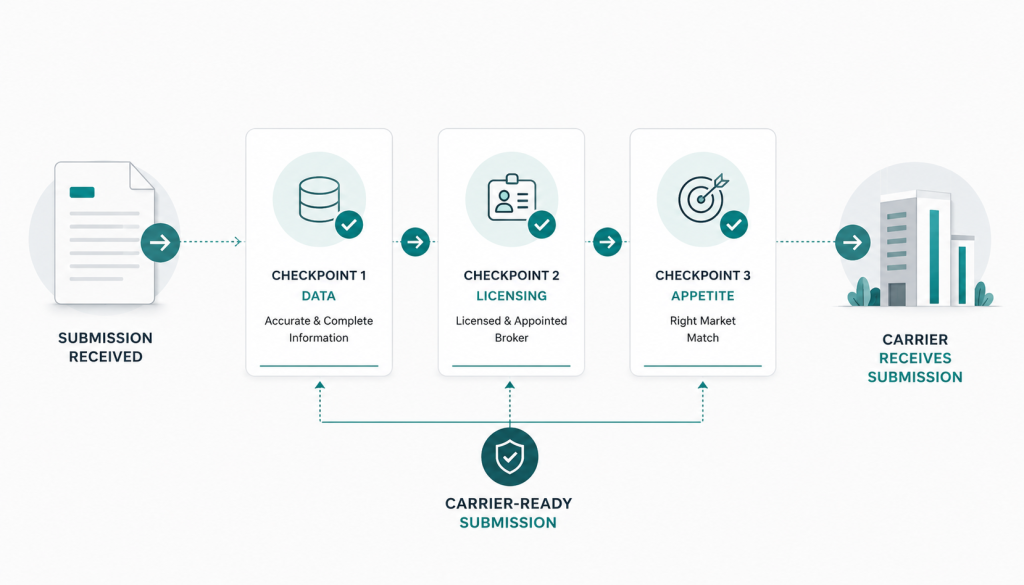
The difference between a submission that gets quoted in under four hours and one that takes five business days is rarely the quality of the risk. But mostly, it’s whether the data is accurate and complete, the broker is licensed and appointed for that market, and the submission goes to a carrier whose appetite matches the account.
Miss any one of these and the submission stalls, gets returned with an information request, or gets set aside in favor of one that arrived ready.
What Makes a Submission Carrier-Ready
How a Carrier Triages What Lands in the Inbox
Underwriters are not waiting to be impressed.
When a submission arrives, the first question is whether it contains enough structured and accurate information to quote.
If it does, it gets worked. If it does not, it gets returned or set aside in favor of submissions that are complete.
The triage happens fast. Underwriters scan for the basics:
- What is the risk?
- What line or respective classcodes are being submitted?
- Who is the broker?
- Is the data usable?
Also, missing exposure details, a broker who is not appointed with that carrier, or a risk outside the carrier’s appetite will stop the submission before it reaches pricing.
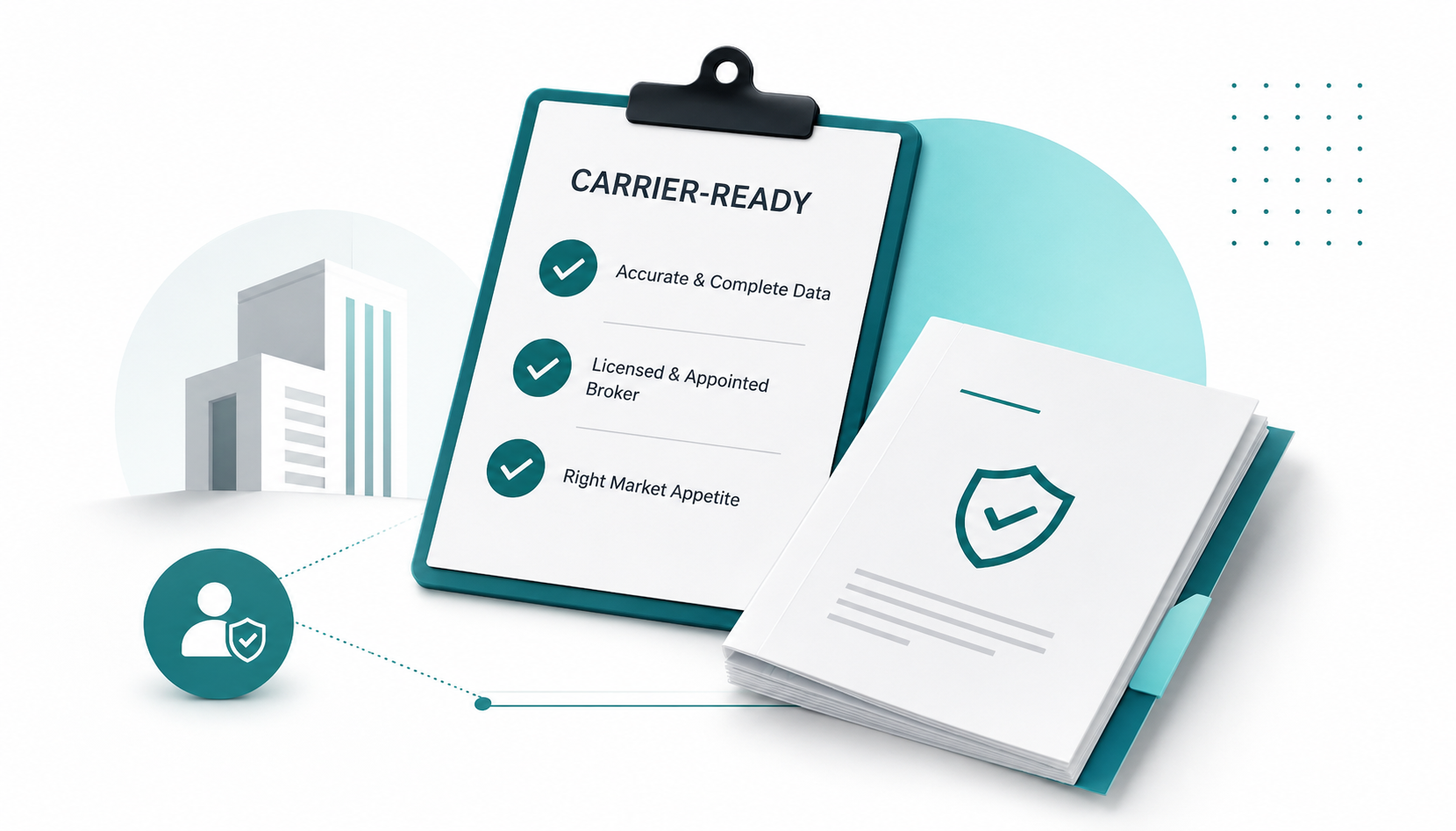
Three Things That Make a Submission Carrier-Ready
expand_more Centered Image close
The first is crisp data. This means accurate NAICS codes, correct EIS codes, complete payroll figures, verified entity information, and loss runs formatted to what the carrier expects. Approximations and inconsistencies trigger underwriter questions that delay the quote.
The second is compliant broker licensing. The submitting broker needs the right license for the state and the right carrier appointment. A submission from an unlicensed or unappointed broker goes nowhere, regardless of how clean the data is.
The third is appetite validation. The submission has to go to a carrier or wholesaler whose guidelines match the risk. Sending a high-hazard account to a carrier that does not write that class wastes the broker’s time and the underwriter’s, and it costs a cycle the broker cannot get back.
Take a broker who sends a complete, accurate workers’ comp package to a carrier that stopped writing that class code in three states last quarter. The data is clean and the broker is licensed. The submission still goes nowhere, because no one confirmed the carrier would write that risk before it went out. That is what appetite validation prevents.
Why Most Submissions Fall Short
Missing or Inconsistent Exposure Data
Exposure data is the foundation of a commercial quote.
- For property, that means replacement cost values, occupancy type, and construction class
- For general liability, it means annual revenue or square footage depending on the class
- For workers’ comp, it means payroll by class code, by state
When that data is missing or pulled from different periods without explanation, underwriters cannot produce an accurate quote. They either ask for corrections or decline.
Inconsistency compounds the problem. A submission where the NAICS code does not match the business description, or where the payroll figures on the ACORD 130 differ from the loss run, signals unreliable data. Underwriters flag these discrepancies and the submission slows.
Incomplete Loss Runs
For most commercial lines, carriers want five years of loss run history. A submission that arrives with two years, or with loss runs that are not current, signals that the broker either could not get the documents from the insured or did not chase them. The conclusion a carrier draws is not charitable: either the broker is disorganized, or the loss history is worse than presented.
Unstructured Supporting Documents
Supplemental applications, inspection reports, and endorsement schedules often arrive as PDFs with no consistent structure. When an underwriter has to manually extract relevant figures from a 40-page document to answer a question the submission should have addressed, the process slows. Carriers operating at volume will deprioritize submissions that require that kind of manual work.
The Workers’ Comp Specifics That Trip Submissions Up
Workers’ comp submissions carry more data requirements than most commercial lines. Payroll must be broken out by state and by class code. The experience modification factor has to be current and sourced from the correct bureau. Entity structure and FEIN need to be verified before submission. These requirements are well known. Submissions still arrive without them.
A Carrier-Ready Checklist
The Minimum Data Set
Before a commercial submission goes out, confirm the following:
Entity information: legal name, FEIN, entity type, state of domicile, years in business.
Classification codes: NAICS code cross-checked against the business description, class codes verified against payroll by state.
Exposure data: complete and sourced from the current policy period, not estimated.
Loss runs: five years where available, dated within 60 days, on prior carrier letterhead.
Broker credentials: license confirmed active for the submission state via the state DOI producer lookup; carrier appointment confirmed by checking the carrier’s appointed producer list, available through the carrier’s agent portal or by request from the carrier’s regional underwriter.
Market selection: carrier or wholesaler appetite confirmed against the class of business, state, and account size before the submission goes out. Surplus lines markets require a separate declination from the admitted market first.
A Quick Self-Audit Before You Submit
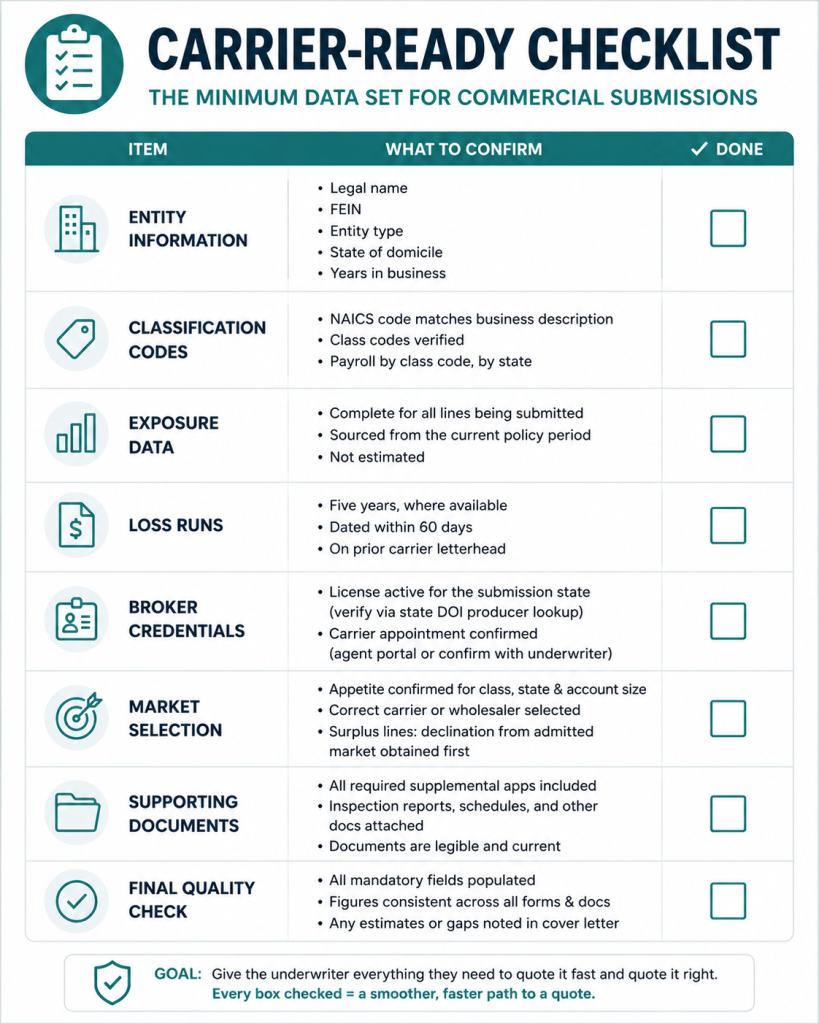
Run through the submission against the carrier’s supplemental application requirements. Confirm every mandatory field is populated. Check that the figures on the ACORD forms match the figures in the supporting documents. If anything was estimated or approximated, note it in the cover letter rather than leaving the underwriter to find it.
A submission that acknowledges its own gaps gives the underwriter something to work with. One that obscures them wastes everyone’s time.
Here is a checklist for you to use:expand_more Centered Image close
What a Submission That Falls Short Costs You
A submission that bounces back for missing information needs to be reworked, re-documented, and re-sent. That cycle costs time, and in a market where a competing broker may already be quoting the same account, it often costs the account. When the back-and-forth does eventually result in a quote, the terms may reflect the friction: a carrier that worked through gaps in loss history or corrected exposure data will price conservatively. The broker placed the account, but not on the terms the account warranted.
How AI Gets a Submission Carrier-Ready
InEvo AI takes a commercial submission from intake to carrier-ready in under four hours. The same workflow handled manually averages around five business days. That gap is where accounts get won or lost.
Extracting and Structuring Messy Inputs
Broker submissions arrive in multiple formats: scanned ACORD PDFs, unstructured Word documents, spreadsheets that do not map to standard fields, loss runs formatted to each prior carrier’s internal template.
AI-based document processing reads across these formats and extracts relevant data into structured fields. On a commercial submission, that means pulling entity name, FEIN, NAICS code, class codes, payroll figures, effective dates, and prior carrier information from whatever document they appear in and mapping them to the correct fields.
Completeness and Consistency Checks
Once the data is structured, it can be checked.
AI runs completeness checks against the field requirements for a given line and flags what is missing before the submission moves. It also runs consistency checks: comparing the stated business type against the SIC code, cross-referencing the limits schedule against the certificate of insurance, and validating that the effective dates across all forms align. These are the same checks an experienced underwriter runs on arrival. Running them before submission means the broker resolves gaps with the insured rather than through a carrier information request.
Formatting to Carrier Appetite
Different carriers use different supplemental applications and have different field requirements. A carrier writing contractors may require a supplemental covering subcontractor exposure and certificate requirements. A carrier writing habitational risks may require a schedule of values formatted to their internal template.
InEvo AI formats submissions to carrier-specific requirements before they go out, so the broker does not rebuild the package for each market.
Validation With a Human in the Loop
The broker reviews the output before it leaves. This keeps the broker accountable for the submission’s accuracy, which matters from an errors and omissions standpoint — if a submission contains inaccurate data and the broker signed off on it, that is the broker’s exposure. The broker reviews output that has already cleared the mechanical checks. That makes it a quality review, not a rebuild.
Get the Front Door Right
Carrier readiness is a defined standard, not a vague quality bar. A submission that clears all three checks before it goes out gives the underwriter what they need to quote it fast and quote it right.
InEvo AI automates the intake and structuring work that gets a submission to that standard. Book a 30-minute call to see it running on your submission type and you’ll leave with a clear picture of where your current intake process loses time and what a configured workflow looks like from day one.
For a closer look at how intake quality affects workers’ comp placement specifically, read How PEOs Reduce Workers’ Comp Costs Through Efficient Intake.