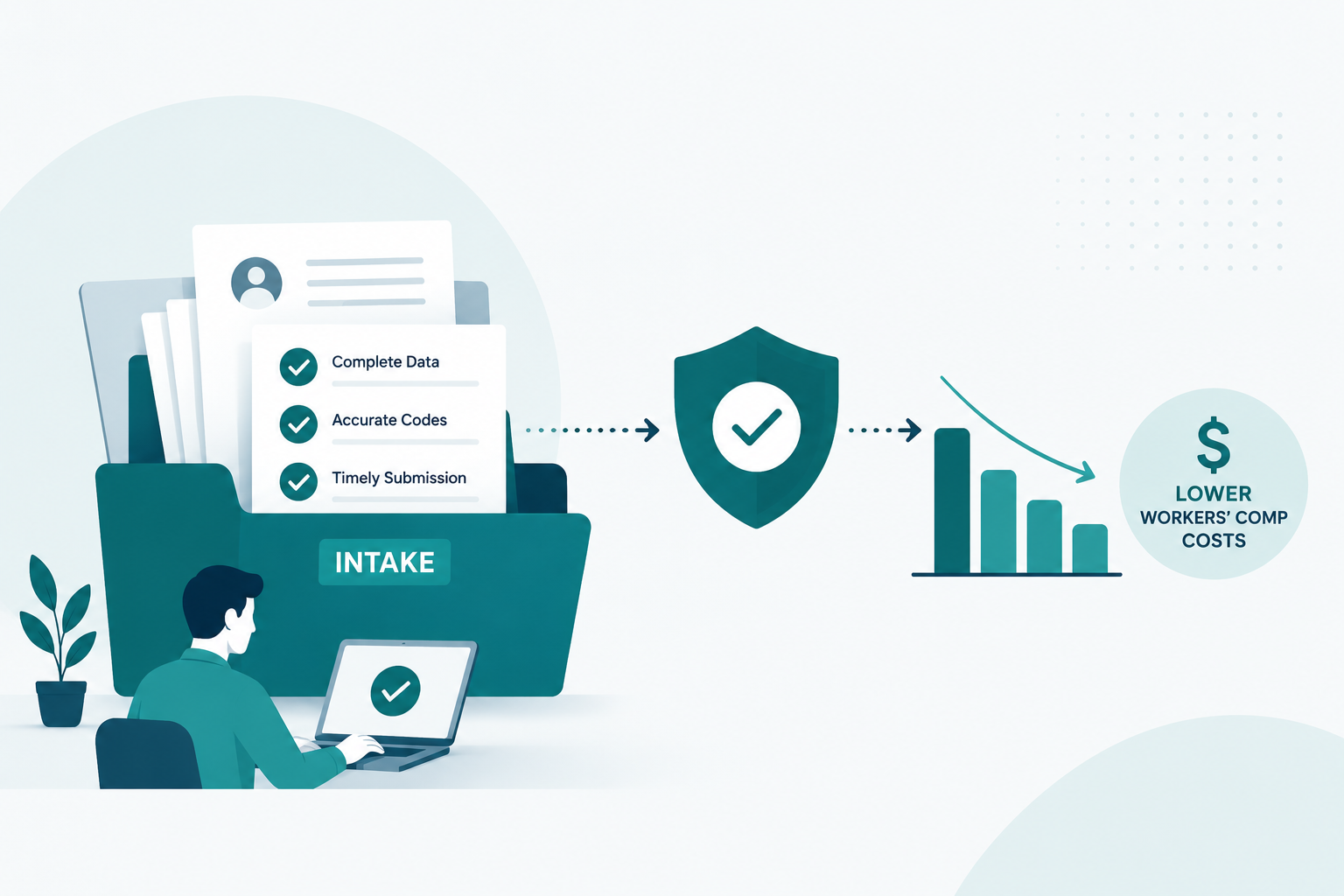
A class code entered wrong at intake follows the submission to the carrier and comes back priced into the quote.
A payroll figure split across the wrong state or a missing experience mod does the same.
The rate a PEO can offer a client is decided at the front door, before a carrier sees the file, and the errors that inflate it are made during intake.
Workers’ compensation makes this harder than any other line a PEO places.
Workers’ compensation net written premium across U.S. private carriers came in at $41.6 billion in 2024, making it one of the most closely scrutinized lines in commercial insurance and one where pricing accuracy at submission directly affects carrier profitability.
A comp submission carries more moving parts than a standard commercial application: payroll broken out by state, a class code for every role, experience modification history and owner elections, each of which changes the rate on its own.
The volume of detail is what makes the errors easy to make and expensive to miss. This piece covers where intake costs a PEO money, how the problem differs across blue-collar and white-collar accounts and how AI structures intake so submissions reach carriers complete and priced correctly.
What messy intake costs a PEO
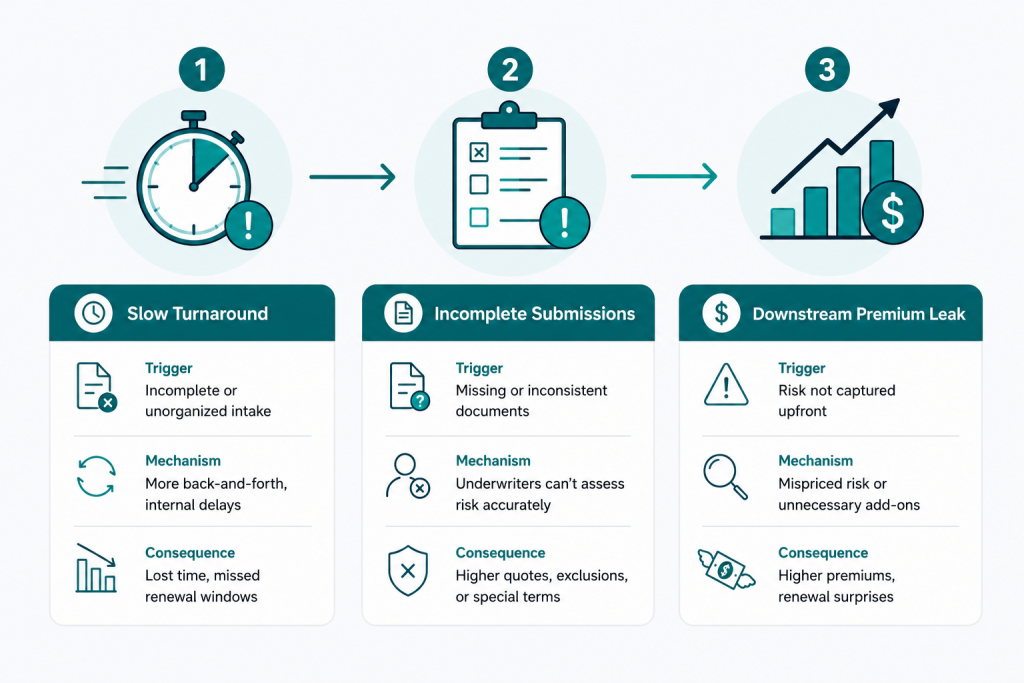
Weak intake creates cost in three ways and the bill arrives later each time.expand_more Centered Image close
Slow turnaround loses accounts
A PEO quotes a 40-person trucking firm on a Tuesday. The submission goes to the carrier that afternoon, missing a driver schedule and an out-of-date experience mod. The carrier sends it back Friday with a list of subjectivities. The competing quote arrived Wednesday. By the time the corrected file goes back Monday, the client has already signed elsewhere.
That sequence plays out across comp submissions every week. A PEO competes for a client against other providers and against the client’s existing broker. The first accurate quote usually takes the account. A PEO that needs a week to assemble a clean submission cannot compete for an account that binds in three days. Speed at intake is the difference between a quote that competes and one that never gets read.
Incomplete submissions bounce back
According to a study, 58% of incoming commercial submissions are missing at least one mandatory underwriting field on first receipt, generating an average of 1.4 broker follow-up touchpoints per file. For a comp submission, that number is higher; the document requirements alone include payroll schedules, loss runs, experience mod worksheets and OSHA classifications, any one of which can trigger a return.
Each trip back costs days. It also costs standing. An underwriter who receives the same file twice has reason to deprioritize it in favor of submissions that arrived ready. Time spent on rework is time a competing quote sits in front of the client unopposed.
The premium that leaks downstream
A construction firm submits payroll of $2.1 million. The intake team enters it against a single state, misses the multi-state split and assigns a class code that fits the employer’s state but not the states where the work is actually performed. The quote comes back and looks competitive. The client signs.
Twelve months later, the audit pulls actual payroll records. The carrier recalculates against the corrected state allocations and class codes. The additional premium bill arrives as a lump sum the client never budgeted for. The PEO loses the renewal.
Wrong inputs produce a quote that looks competitive and prices the risk incorrectly. The error passes through intake unnoticed, and the client signs on the strength of a number that was never real. It surfaces at audit or at renewal, when the correction costs the client money and costs the PEO the account.
Blue-collar clients, where comp gets expensive and intake gets hard
Blue-collar accounts carry the heaviest comp exposure and the most demanding intake. A construction firm, a trucking company or a manufacturer brings payroll spread across several states, a range of job classifications and a fleet of drivers. The data that prices the account correctly is large, detailed and easy to get wrong.
Multi-state payroll is where the detail runs deepest. A worker who crosses state lines has to have payroll allocated to the state where the work is performed, not the state the employer is based in, and each state prices the same job differently. Some states set comp rates through NCCI. Others run their own rating bureaus with their own class codes, so the code that fits a role in one state has no exact match in the next.
A handful of states require coverage through a state fund, which is outside the carrier submission altogether. An intake team working a multi-state crew has to assign the right state, the right bureau’s class code and the right rate to each segment of payroll before the submission means anything.
Payroll itself is not a single number. In many states the premium portion of overtime is removed before the rate is applied, so counting gross overtime overstates the basis and the premium with it. Owners and officers can often elect in or out of coverage, and several states cap the payroll used for those who stay in. Each of these adjustments changes the exposure the carrier rates. Entered straight from a payroll export without them, the figure is wrong in the carrier’s favor, and the client pays the difference.
Errors on blue-collar accounts carry the largest premium consequence. The underlying exposure is high, so a small classification mistake becomes a large swing in cost. A worker placed in the wrong class code on a high-hazard account can shift the premium by a wide margin, against the PEO or against the client. The same mistake on a low-hazard account would barely register. On these accounts it sets the economics of the whole program.
An incomplete blue-collar submission shapes what the underwriter sees. With schedules or classifications missing, the underwriter cannot rate the account on its real exposure. The choices are to return it with a list of subjectivities, to set it aside for files that are ready to quote or to price in a margin that covers the gap the data leaves open. Each choice works against the PEO:expand_more Centered Image close
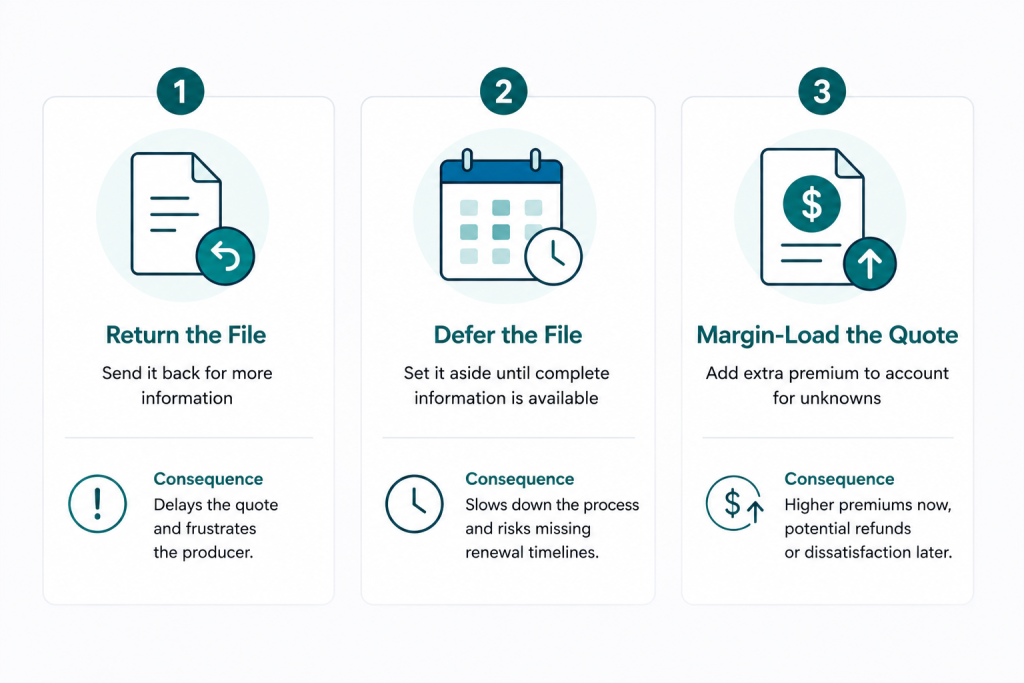
The missing data reads as exposure the underwriter has to assume is there.
A complete blue-collar submission reads the other way. When the payroll is allocated by state, every role carries the right class code, the experience mod matches the rating bureau and the driver schedule arrives with motor vehicle records attached, the carrier can rate the account on what it actually is. There is no gap to price for. The file moves to the front of the queue, and it reads as the work of a PEO that knows the class of business and will bring more like it. With the full picture in hand, the underwriter prices the account on its merits.
White-collar clients, lower risk but different traps
White-collar accounts look simple at intake. An office-based professional services firm carries low physical hazard and a payroll that appears clean. The chance of getting the submission wrong feels low.
The errors on these accounts are quiet ones.
A role gets placed in a clerical class code when part of the work belongs in a higher one. A FEIN is missing or entered incorrectly. The entity structure goes unverified, so the carrier cannot confirm who is actually being covered. None of these stops the submission from looking complete on the page.
The trap that catches the most white-collar accounts is called entity structure. A professional firm rarely runs as a single company. There is often a holding entity, one or more operating entities and a separate payroll entity, each with its own FEIN, and the workers sit under one of them rather than the name on the front of the application.
Submit under the wrong entity and the policy covers a company that does not employ the people on the schedule. Miss a related entity and a group of workers has no coverage at all. The carrier cannot see any of this from a clean-looking application. It surfaces when a claim is filed against an entity the policy does not name, and by then the gap is real.
Classification is a bit tricky too. The clerical rate applies to genuinely clerical work, and the moment an employee spends part of the day in a different setting, a warehouse, a job site, a service call, the clerical code may no longer hold. A firm that books every back-office head as clerical, without checking the split of duties, understates its rate base. The error is small on any one head and adds up across the payroll.
These mistakes are harder to catch by hand than blue-collar errors. A high-hazard account draws scrutiny so a reviewer checks it closely. A white-collar account looks tidy so it passes review with a glance and the errors ride along inside it. Nothing forces them into view during the policy term. They are in the file until the year-end audit pulls actual payroll and entity records and the firm quoted as the safe, easy account receives a correction it never saw coming.
How structured intake fixes the rate problem
Hand-keyed data is behind these errors. A figure is entered once by a person, copied from one form to the next and checked late, if at all. Structured intake breaks that pattern. It captures each data point once, verifies it at the point of entry and maps it to every form the carrier requires.
Data captured once, mapped across every form
A structured intake process takes each piece of information a single time. A workers’ comp submission is not one document. The same payroll figure feeds the application, the state supplements, the experience mod worksheet and the exposure schedule, and a manual process rekeys it into each one with a fresh chance to differ. Structured intake fills them from a single source, so the number that prices the account reads the same everywhere it appears. It carries the state allocation, the overtime adjustment and the owner elections with it, rather than leaving each form to be corrected by hand. The transcription errors that move the rate have nowhere left to enter, and the hours spent reconciling one form against another disappear.
Verification at the point of intake
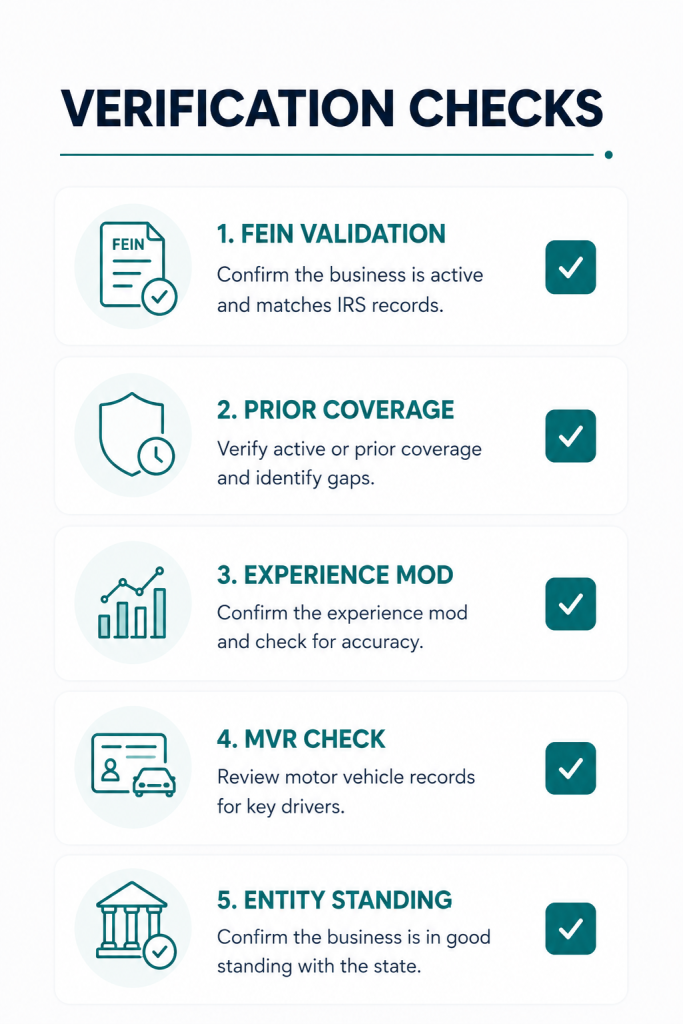
Structured intake checks the data against the sources a carrier would use to verify it. Business identity and entity standing are confirmed against the public record, so the submission names the entity that actually employs the workers.expand_more Centered Image close
On a fleet account, that is the difference between a schedule the carrier trusts and one it has to question. Every check happens at intake, ahead of the carrier returning the file with the same question.
A submission verified this way reaches the carrier with its questions already answered. The underwriter is not chasing a missing FEIN or an unconfirmed entity, so the file moves through rating instead of sitting in a queue of things to follow up.
InEvo AI runs these checks at intake, drawing on the same sources underwriters rely on to assess a risk. A reviewer still signs off on the work with the checks and the source data assembled in front of them.
What this does to turnaround
Speed follows from getting the data right the first time.
Carriers that have automated submission intake have documented quote turnaround reductions from three to five business days down to under four hours without changing their underwriting criteria, only the data handling step before it.
A submission that does not bounce moves straight through to the carrier, and a submission the carrier can read without follow-up gets quoted sooner.
In InEvo AI’s deployments, a file moves from inbox to carrier-ready in under four to five hours, against around five days for the same work completed manually. For a PEO quoting against a slower competitor, this decides which quote reaches the client first.
The advantage compounds across volume. An intake team that clears each file in hours rather than days carries more accounts through the same week without adding headcount, so the PEO can quote business it would otherwise have turned away for lack of time. A faster and cleaner submission improves the position on two fronts at once. The quote is accurate, so it prices the risk correctly and holds up at audit. The quote is early, so it reaches the client ahead of a competitor’s. The competitive rate a PEO wants to offer rests on both being true together.
Building intake that keeps rates competitive
Structured intake settles the trade-off but only if the process is built around the right properties. Before the next comp submission leaves your desk, run it against these three checks.
Structure: was this data captured once or rekeyed multiple times?
Verification: have you answered the questions the carrier will ask?
Turnaround: will this quote reach the client before a competitor’s does?
A PEO that clears all three checks on every submission quotes accurately and quotes early. That combination is the competitive position. InEvo AI runs structure, verification and turnaround in one pass at intake, so the file leaves the desk fast and correct and the rate it carries holds up when the carrier looks at it.
Where the rate gets won
InEvo AI works at the point of intake, checking each submission against the same sources a carrier uses so files arrive complete and priced right the first time.
The setup runs as a six-week pilot configured to your comp lines and your carriers’ guidelines, working on your real submissions from week one.
You see it handle your own volume, not a demo built on sample data.
Book a 45-minute call to see InEvo AI handling your submission volume.