
If you’re a commercial insurance broker, you already know where your day goes. Client conversations and complex risk decisions take a back seat to emails, PDFs, renewal spreadsheets and carrier portals. The actual work of brokering gets squeezed into whatever’s left.
Commercial insurance operations have always been documentation-heavy, and the intake process alone creates a significant amount of back-and-forth. Wrong documents submitted, outdated certificates, missing information that sends brokers back to clients for a third or fourth time, incomplete applications that stall submissions before they even reach a carrier. All of that lands on teams that aren’t getting bigger.
According to BCG, administrative tasks consume more than 50% of a broker’s time on average (emails, document review, renewal prep, carrier /wholesaler coordination).
AI is here to help with that by taking on the operational work that was never the best use of broker time in the first place.
Why More Commercial Insurance Agencies Are Starting to Use AI
The workload problem in commercial insurance isn’t new.
Agencies are managing larger books of business with teams that have stayed roughly the same size. Experienced account managers are stretched thin. A significant chunk of institutional knowledge lives with a handful of senior people, renewal handling, appetite check/ carrier preferences, how to read a client’s loss history.
When these people are stretched, everything slows down.
A producer needs to prepare a submission. They pull information from a prior application, cross-reference an email thread, check a spreadsheet for loss history, log into two carrier portals, then manually organize everything into a format the underwriter can use. That’s before they’ve written a single word of the actual submission. It takes hours and happens dozens of times a week across the agency.
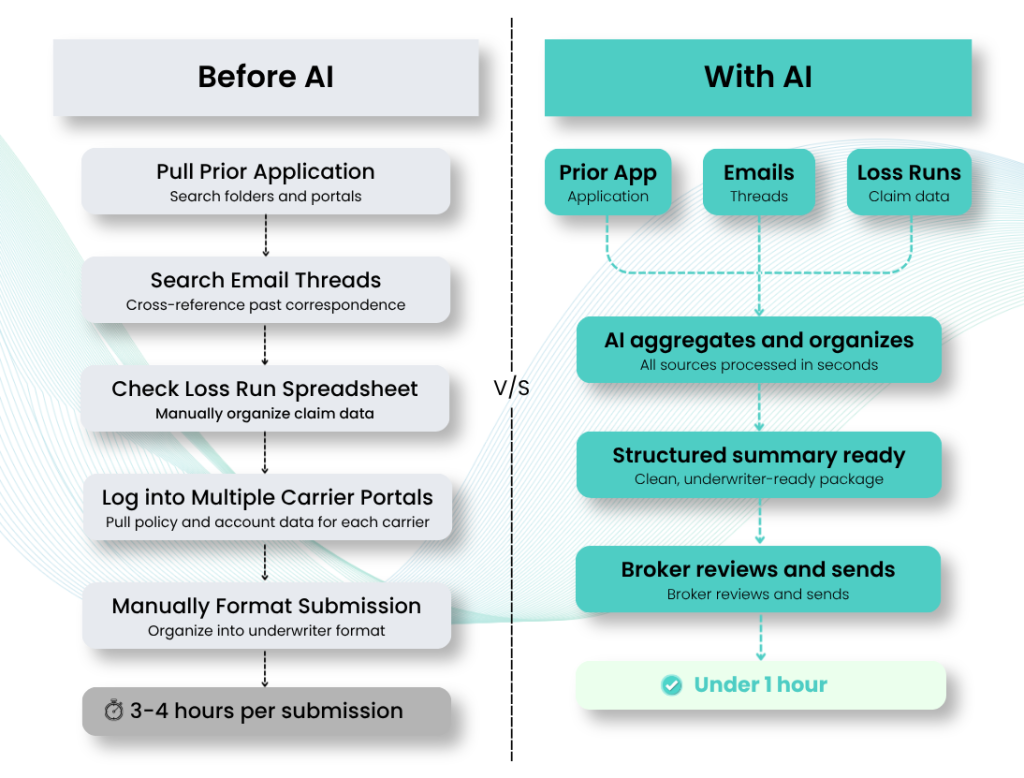
Source: BCG, Applied Systems Voice of Customer Survey
Agencies are adopting AI because the manual coordination holding their workflows together is becoming harder to sustain as business grows.
The agencies moving fastest have been honest about where operational time is actually going, and have started looking for a better answer.
How AI Is Changing Workflows Across Commercial Lines of Business
How AI Is Supporting P&C Insurance Operations
P&C is one of the broadest lines in commercial insurance, covering property, liability, workers’ compensation, inland marine and more. Each of those lines carries its own documentation requirements, policy structures and renewal workflows.
For teams managing accounts across multiple P&C lines, the operational load adds up fast.
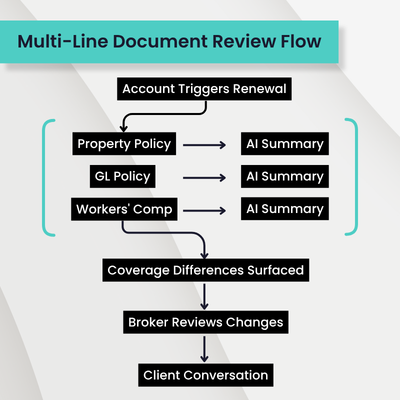
Document review is one of the clearest examples of where AI is reducing that load. On a mid-sized commercial account with property, general liability and workers’ comp all renewing together, a broker is typically working through declarations pages, endorsement schedules, coverage summaries, loss runs and ACORD forms often across multiple carriers, each formatting them differently. Identifying what changed year over year across all of that can take the better part of a morning. AI surfaces those differences across each document quickly, so the broker spends their time on what the changes actually mean for the client rather than finding them.
Loss run analysis follows a similar pattern. A loss run report typically covers five years of claims history and can run anywhere from a few pages for a straightforward account to a dense, multi-page document for a business with claims across multiple lines or carriers. The added complexity is that each carrier formats them differently. Different layouts, different column structures, different levels of detail. So before a broker can actually review the data, they have to organize it first.
For a simple loss run, that process takes 15 to 30 minutes. For a complex account with multiple years of history across multiple carriers, it can take one to three hours per submission, before any actual analysis begins. AI can structure that information across formats, summarize claim trends and flag areas worth closer attention so the broker walks into the renewal discussion having already reviewed the data rather than still sorting through it.
Submission preparation is another area seeing real change. Producers and account managers typically gather information from emails, prior submissions and applications before anything goes to a carrier. When an account spans multiple lines, that process multiplies. AI can pull that information together into organized summaries for each line, reducing back-and-forth with underwriting teams and shortening the overall submission cycle.
How Commercial Auto Insurance Teams Are Using AI to Reduce Manual Work
Commercial auto operations involve a specific kind of repetitive work. Fleet schedules, driver records, vehicle details, claims history and renewal documentation require constant updates, and the information rarely sits in one place.
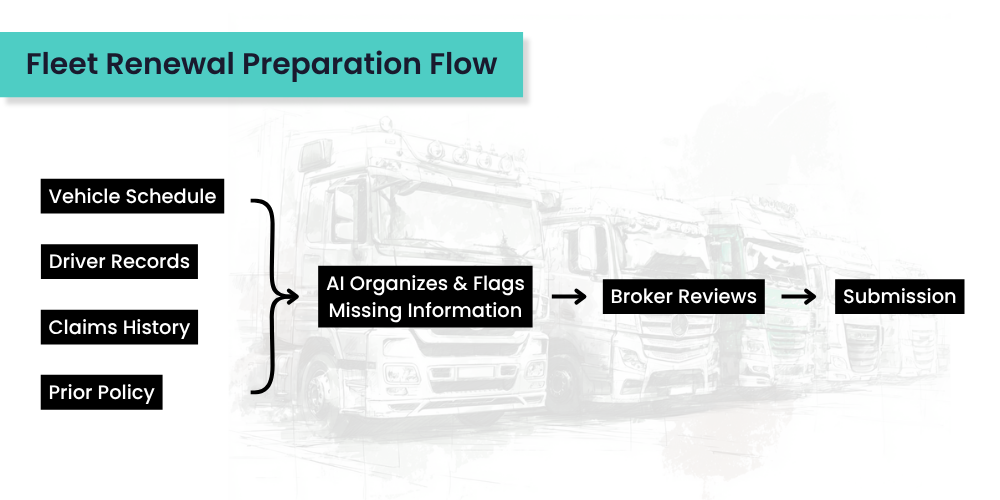
Fleet documentation review is one of the more straightforward use cases. Instead of going through vehicle schedules and driver applications line by line, account managers are using AI to summarize schedules and organize data before submissions go out. On a fleet account with 50 or more vehicles, that kind of pre-submission review can take most of an afternoon. AI helps the broker right from gathering data to coverage review.
Certificate requests are another area where commercial auto teams are seeing consistent time savings. Clients with large fleets often need multiple certificates issued across different locations, entities and contractual requirements.
- Certificates of liability insurance
- Commercial auto liability certificates
- Motor truck cargo certificates and workers’ compensation certificates
Sometimes all at once and each needing accurate policy numbers, coverage limits and expiration dates. A separate certificate may be required for each line of coverage, and a single client can generate dozens of requests. Organizing that information, verifying the details against current policy documents and preparing each certificate manually creates a steady operational drain. AI can handle the compilation and verification work, freeing account managers to focus on accuracy checks before anything goes out.”
Communication workflows are also changing. Teams are using AI to prepare first drafts of renewal emails, organize follow-up communication with carriers and explain documentation requirements to clients. The broker still reviews and sends everything, editing rather than writing from scratch. Across a busy renewal period on a large book of auto accounts, that shift adds up.
How AI Is Being Used in Commercial General Liability (CGL) Insurance
CGL policies involve complex language, layered exclusions and coverage considerations that require attention. Comparing policy versions, identifying what changed and explaining those changes to clients is time-consuming work.
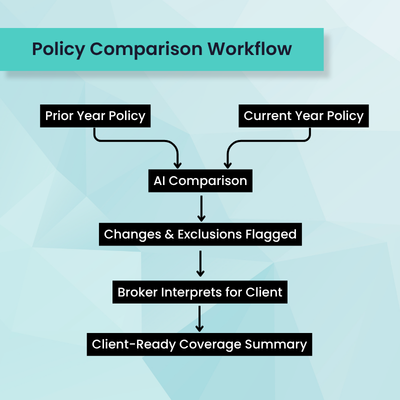
Policy comparison is one of the more practical applications. Teams are using AI to identify changes between policy versions, summarize exclusions and organize coverage information before internal review. The broker still interprets what those changes mean for a specific client or industry. AI surfaces the information faster.
Client communication is another area where AI is adding value. CGL policy language is genuinely difficult for most clients to parse. Terms like the contractual liability exclusion, the pollution exclusion, the professional services exclusion and the expected or intended injury exclusion carry specific legal meaning that rarely matches what a business owner assumes when they first read them.
A client who believes their CGL policy covers a pollution-related incident, a professional services claim or a cyber liability event may find out at claim time that it doesn’t because those exclusions were never clearly explained at renewal. Instead of drafting those explanations from scratch for every account, brokers are using AI to prepare first-pass summaries of the exclusions and conditions most relevant to that client’s business, which they then review and customize before sending. Across a large book, that shift adds up meaningfully over a quarter.
Claims-related workflows are changing as well. Manually processed claims have historically taken weeks to move through review and resolution and claims handlers spend roughly 30% of their time on low-value administrative work like organizing documents, logging data and preparing summaries rather than actually managing the claim.
Insurers using AI have reported cycle time reductions of 50 to 75%, with some cutting average settlement time from three weeks to a matter of days. For brokers, the immediate impact is on preparation.
How AI Is Improving Underwriting and Servicing Workflows
Underwriting and servicing are where a lot of the operational friction in commercial insurance actually lives. Information moves between producers, account managers, carriers and servicing teams throughout the lifecycle of an account, and most of that movement is still manual.
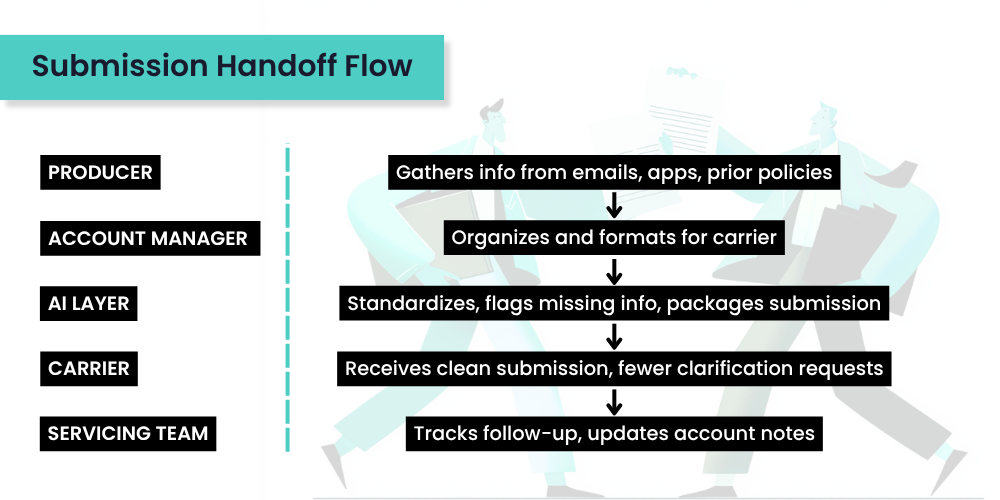
Submission preparation is one of the bigger pain points. Teams using AI to organize and summarize that information are producing cleaner submissions faster, which tends to reduce back-and-forth with carriers during the quoting process.
On the servicing side, account managers are using AI to pull renewal briefs, summarize prior client conversations and organize account activity without digging through multiple systems. That kind of fast information retrieval changes how a broker prepares for a client call. Instead of spending 20 minutes pulling together context before a meeting, they spend that time on the conversation itself.
Operational consistency is another area where AI is making a practical difference. Commercial insurance workflows often vary between teams and individual employees, which creates inconsistencies in documentation, communication and servicing quality across accounts. AI-assisted workflows help standardize how information is captured and organized, which matters more as books of business grow and teams need to maintain quality without adding headcount.
What AI Can Help With And What Still Needs Human Brokers
The Types of Insurance Tasks AI Can Already Help With
The work AI handles best in commercial insurance is repetitive, document-heavy and time-consuming. That covers a significant portion of what most servicing and account management teams deal with every day.
Document review and summarization is the most common starting point. Instead of reading through full policy documents to find what changed, brokers are using AI to surface coverage differences, flag exclusions and organize endorsement details. The broker still interprets what those changes mean for the client. AI gets them to that point faster.
Renewal preparation is another area where AI is reducing manual work in a meaningful way. Pulling together account history, summarizing prior claims, organizing servicing notes and preparing briefing documents before a renewal meeting used to be a multi-hour task on a complex account. A survey found that managing renewals was the single most inefficient task agencies deal with. Teams using AI to handle that preparation are walking into renewal conversations better prepared and with more time for the actual discussion.
First-draft communication is a smaller but consistent time saver. Renewal emails, coverage explanations, carrier follow-ups and client updates all follow recognizable patterns. AI produces a solid first draft that the broker reviews and customizes, which is faster than writing from scratch across every account every week.
Internal information retrieval is one of the less obvious use cases, but in practice it’s one of the more valuable ones. Account information in most agencies doesn’t live in one place. A client’s prior coverage discussion might be in an email thread from eight months ago. The reason a particular endorsement was added is in a servicing note buried in the agency management system. A carrier’s specific appetite for a risk type was mentioned in a producer call summary no one can find. Before a renewal meeting or a client call, an account manager might spend 20 to 30 minutes pulling that context together manually. Opening the AMS, searching emails, scanning old notes just to walk into a conversation feeling prepared.
Platforms like Applied Epic and Vertafore AMS360 are now embedding AI directly into their systems to address exactly this problem.
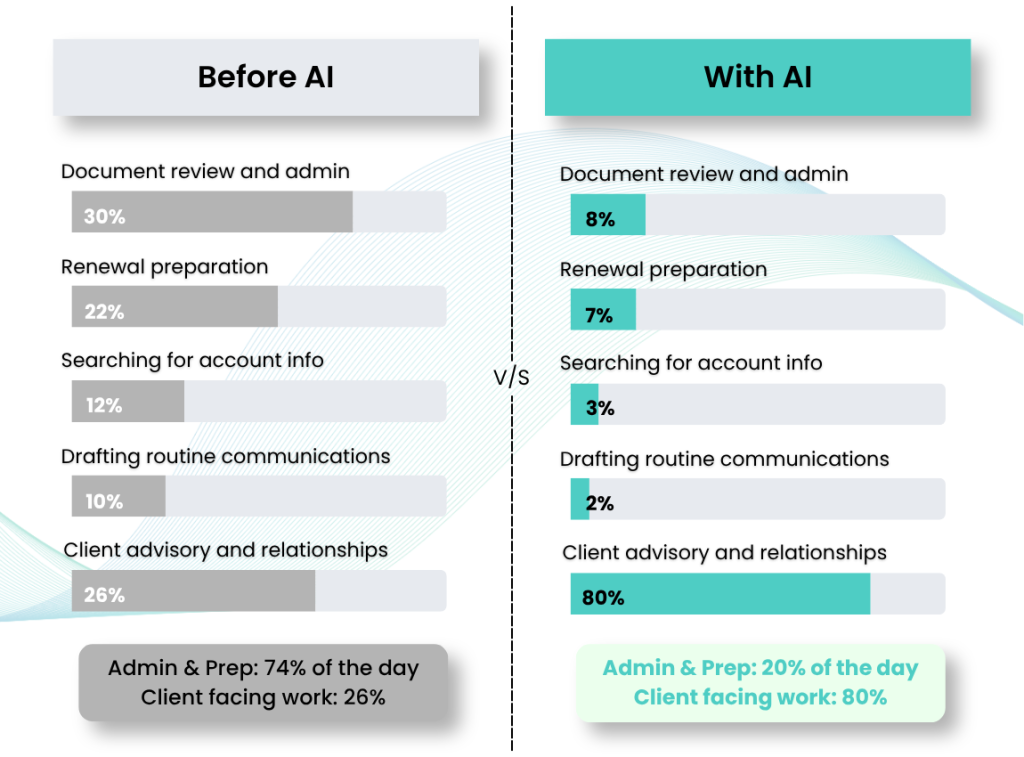
Illustrative breakdown based from BCG (2025): admin tasks consume 50%+ of broker time
The Parts of Commercial Insurance That Still Need Human Expertise
The operational tasks AI handles well are real, but they’re not the whole job. The parts of commercial insurance that depend on broker expertise are also the parts clients value most.
Complex risk evaluation is one example. A cannabis dispensary operating across three states, each with different regulatory requirements and coverage mandates, presents a risk profile that no standard framework fully captures. Figuring out where the coverage gaps are, which carriers will even write the account and what terms are realistic in that market requires the kind of contextual judgment that comes from experience.
Carrier negotiation is another area that depends on people. On a complex commercial account, a broker might approach anywhere from 5 to 15 carriers to market a single policy and knowing which ones to approach, in what order, and how to position the risk for each one is itself a skill. Getting the right carrier to the table, then negotiating pricing, coverage terms and policy structure based on that carrier’s current appetite and the broker’s existing relationship with their underwriters, that process depends on judgment and trust that no document summary can replicate.
Client advisory work is where the broker relationship is most visible and most at risk if operational drag gets in the way. A client who waits three days for a coverage explanation, receives a renewal summary that doesn’t reflect their actual operations, or can’t get a straight answer on a claim in progress loses confidence in their broker quietly and quickly. That erosion rarely shows up as a formal complaint. It shows up at renewal, when they’re more receptive to a competitor’s pitch.
What clients actually need from their broker is someone who understands their business, explains their exposures clearly, and shows up to every conversation prepared. That requires professional judgment and accountability that no AI system can replace.
This is exactly the gap that platforms like Inevo AI are built to close. Inevo AI gives brokers back the time and context they need to show up as genuine advisors rather than administrators. The broker relationship stays human. The work supporting it doesn’t have to be.
Compliance and coverage decisions also remain firmly in broker territory. When a recommendation is made to a client, a coverage decision is documented or a policy interpretation is communicated, a licensed professional is accountable for that advice. AI can support the preparation work around those decisions. Accountability stays with the broker.
A broker who spends less time on document prep and more time with clients delivers better service, and clients notice.
Why Simple AI Experiments Are Not Enough for Insurance Agencies
Commercial insurance agencies have already started experimenting with AI in some form. By mid-2024, 76% of US insurance companies had implemented generative AI in at least one business function, and full AI adoption across the value chain jumped from 8% to 34% in a single year.
Why Many Insurance Agencies Struggle to Successfully Adopt AI
The gap between experimenting with AI and building it into operations comes down to governance. Most agencies don’t have it yet and general-purpose tools like ChatGPT and Claude weren’t built to fill that gap.
A broker is preparing a renewal submission. They’re short on time, so they paste the client’s loss run directly into ChatGPT to get a quick summary. The document contains the client’s business name, employee headcount, claims history and financial details. The broker gets the summary they needed. What they didn’t consider is what happened to that data.
A 2024 study found that 73% of employees paste sensitive data into AI chatbots without recognizing the risk. In commercial insurance, that data includes business financials, employee records, claims history, policy details and legal documentation. These aren’t low-stakes documents.
When a broker pastes a client document into a consumer AI tool, they’re potentially exposing Personally Identifiable Information (PII) which in commercial insurance includes client legal names and business addresses, federal tax ID numbers, employee headcounts and payroll figures, individual claims details tied to specific employees, loss history that could affect a client’s ability to obtain coverage, and financial records used to calculate premiums. In most US states, brokers have a legal obligation to protect this information.
Consumer versions of ChatGPT use conversations to train models by default, with data retained for 30 days even if you opt out. Anthropic’s Claude shifted to an opt-in and opt-out model in 2025 for consumer accounts, with data potentially retained for up to five years for users who opt in. Most brokers using the free or standard consumer versions of these tools aren’t on enterprise agreements. They’re operating under standard consumer terms, which offer far fewer protections.
The same data risk applies across Claude, Gemini, Copilot and every other hosted AI model. Whether the agency has a Data Processing Agreement in place, what product tier they’re using, and whether they can account for what client data has been shared and when, those are the deciding factors. Most agencies using AI informally cannot answer those questions.
The Difference Between Using AI Tools and Building AI-Assisted Operations
Occasional use of ChatGPT or Claude for drafting and summarizing is useful. Building operational workflows around AI is a different undertaking.
General-purpose AI tools are built for broad use across any industry. They don’t understand carrier workflows, agency management systems, underwriting processes or the compliance requirements specific to commercial insurance. Best practice when using general AI tools with any sensitive document is to mask or redact identifying information before sending, and to operate through zero-retention API configurations where possible. Most teams using these tools informally aren’t doing any of that.
SOC 2 Type 2 certification is the industry benchmark for data security in SaaS and cloud-based platforms. It requires an independent audit confirming that a vendor’s data handling controls have been operating effectively over a sustained period, not just at a single point in time. General-purpose AI tools like ChatGPT and Claude are not SOC 2 Type 2 certified for consumer-tier accounts.
The agencies moving beyond experimentation are looking at a different category of solution. Commercial Insurance-specific AI platforms are built with compliance frameworks, audit trails and data governance controls as part of the product. Some platforms already ship with per-step audit trails built specifically for regulated insurance workflows, a meaningfully different capability from a general-purpose chatbot. The ability to show exactly what data was processed, when and how, matters when a client asks or a regulator needs answers.
Why Redesigning Workflows Matters More Than Automating Individual Tasks
Using AI to speed up individual tasks saves time. It doesn’t solve larger operational problems if the workflow underneath those tasks is still poorly designed.
An agency might use AI to draft client emails faster, but if the account information feeding those emails is still scattered across three systems and two email threads, the bottleneck hasn’t moved. It’s just downstream now.
The agencies are rethinking how work moves across their operations. How submissions are organized before they go to a carrier. How account information is captured and stored so it’s usable next year. How servicing notes are written so the next person on the account has context without needing to ask.
AI makes a well-designed workflow faster. A poorly designed workflow stays broken.
For agencies handling sensitive insurance data across multiple accounts and carriers, that distinction is worth taking seriously before expanding AI use further.
Why Client Experience Is Becoming More Important in Commercial Insurance
Operational efficiency isn’t just an internal concern. It shows up directly in how clients experience working with their broker.
Commercial insurance clients now measure their service experience against every vendor they deal with.
- Banking apps that surface information instantly
- Software platforms that send proactive updates
- Vendors who respond within the hour
That bar has moved into commercial insurance as well.
Most client frustration in commercial insurance comes from the operational experience surrounding those decisions.
- Waiting days for a renewal update
- Getting asked for the same document twice
- Receiving a summary that doesn’t match what was discussed in the last meeting.
These are symptoms of workflows that weren’t built with the client’s experience in mind.
What the Future of Commercial Insurance Operations Could Look Like
The agencies that will operate most effectively over the next few years are the ones building cleaner, faster workflows, regardless of how many AI tools they’ve adopted.
Submission packages that required back-and-forth across three systems get organized in a fraction of the time. Account managers walking into client calls are better prepared, spending less time on work that didn’t require them specifically and more time on the conversation itself. Servicing teams are handling more accounts without the back-and-forth that used to slow everything down.
That operational improvement compounds. An agency running tighter workflows handles growth without adding headcount at the same pace. Accenture found that 50% of insurance executives believe automation could reduce operational costs by up to 20%, that reduction shows up in the coordination overhead that slows every team down.
It retains clients more consistently. It attracts brokers who want to spend their time on substantive work rather than administrative coordination.
Most agencies start with one workflow, submission organization, client communication or internal information retrieval, and build from there. Picking the right starting point matters less than making it repeatable.